By Kees Wiegers, PA5CW (ex-PA3BHS)
It looked impossible to get a large beam for 20 meters up a tower, but it was something I always wanted. So after attending a presentation by John Devoldere, ON4UN, of Merelbeke, Belgium, I decided to try and build my own beam.
At the presentation, John demonstrated software for designing Yagi antennas. From a collection of about 100 antennas you could choose the most suitable for your needs. I was interested in a compact beam for the 20 CW part of the band. If you choose a narrow bandwidth such as for the CW portion of the band, you can optimize gain and front to back ratio for that part of the band.
Once you have chosen the beam design, you can decide on the mechanical construction. For example, what kind of construction to choose for connecting the elements to the boom (boom/plate, isolated from the boom etc.). And what kind of matching system you want to use. Then, decide on the material for the elements. If you use thick material or thin material, the consequences are that the beam is more or less rigid and the elements bend more or less in heavy winds or when there is ice on the elements.
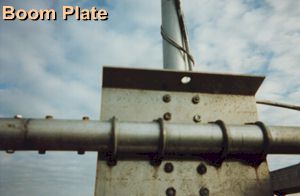
I made an inventory on materials present at the local hardware stores. The hardest part to get was the material for the boom. The boom is 5 meters long and 50mm diameters and 3 mm thick. I had to get it from a large supplier. I also bought the thick plate for the boom / tower connection which is 300 by 300 mm and 4 mm thick.
After locating all the right materials, I calculated the size for the elements using the program. Then, I optimized the antenna by tuning the elements in the program and the gamma match for the CW part of the band.
| Frequency: 14.1 MHz Boom length: 4.58m (15 ft) Gain:7 dB F-T-B ratio:25 dB | Reflector Dipole Director | # sections 4 4 4 | Position from dipole -192.5cm (-6.3 ft) 0 265.7cm (8.7 ft) |
| Reflector Section | Diameter mm (inch) | Length cm (feet) | Overlap cm (feet) |
| 1 | 30 (1.2) | 200 (6.56) | |
| 2 | 25 (.98) | 200 (6.56) | 10 (3.94) |
| 3 | 20 (.79) | 200 (6.56) | 10 (3.94) |
| 4 | 16 (.63) | 188.8 (6.2) | |
| Dipole Section | Diameter mm (inch) | Length cm (feet) | Overlap cm (feet) |
| 1 | 30 (1.2) | 200 (6.56) | |
| 2 | 25 (.98) | 200 (6.56 | 10 (3.94) |
| 3 | 20 (.79) | 200 (6.56) | 10 (3.94) |
| 4 | 16 (.63) | 156.4 (5.13)) | |
| Director Section | Diameter mm (inch) | Length cm (feet) | Overlap cm (feet) |
| 1 | 30 (1.2) | 200 (6.56) | |
| 2 | 25 (.98) | 200 (6.56) | 10 (3.94) |
| 3 | 20 (.79) | 200 (6.56) | 10 (3.94) |
| 4 | 16 (.63) | 123.7 (4.06) |
| Gamma Match | |
| Impedance at feed-point: | 26.3 Ohm |
| Feed line: | 50 Ohm |
| Diameter gamma match: | 13 mm (.51in) |
| Distance from dipole: | 10 cm (.39in) |
| Length: | 110.7 cm (3.63ft) |
| Series Capacitor: | 301 pF |
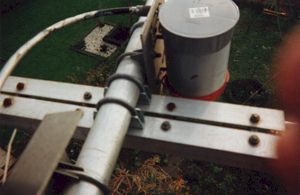
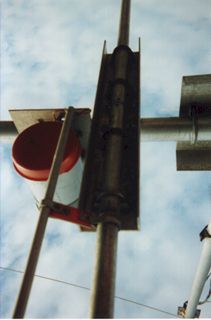
Then I went to the shops and collected the materials. After that, I had a pile of aluminium from 50 cm high. The capacitor of the gamma match was enclosed in a piece of PVC material (110 mm) of the type used as sewer pipe, and closed on both ends with a cap. The elements were connected to the boom with aluminium L-material and muffler clamps (like the beams I described in previous issues). I cut the boom in 2 halves because it did not fit in the car. I the connected it with a smaller piece of tube which fit into the boom. After assembling the antenna (it filled out the whole garden), I took it up into the tower.
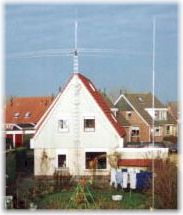
Then the moment was there to see if the calculations were correct! I switched on the transceiver and went to the tower with a SWR meter connected directly to the gamma-match. The SWR was 1 to 1.5, when I tuned the capacitor; it was 1 to 1! Then I rushed down and went to the shack. I tuned for a signal and turned the antenna around. It was amazing to see the S-meter drop as I turned the antenna, it performed like a 2-meter beam, and I could determine the exact location of a station. When I tuned for the east (USSR) the signals where 5-9 plus, and when I tuned for the west (USA) the signals from the east disappeared and the USA signals came up.
One of the first QSOs was when I tuned for the NCDXF beacons at 14.100. The band looked in bad shape and there were only a few European stations heard. After listening for the beacons, I heard the KH beacon with signal strength of S5-S6. I started calling CQ and a KH6 station answered my call. He gave me 5-9 plus. After the QSO another Dutch ham with a 3-element tri-band Yagi called the KH6 station, but the KH6 station did not hear him!
So the beam is an excellent performer and has survived many heavy winds and icy winters. It’s been up now for 7 years and I have not had to replace any of the parts.
Good luck with building this wonderful antenna
Article by By Kees Wiegers, PA5CW (ex-PA3BHS)
Article originally available at http://www.antennex.com/preview/archive3/twrbeam.htm