Skip to content

IW5EDI Simone – Ham-Radio

Amateur Radio made in Italy

Menu
  • About me
    • QSL info
    • Log Book OnLine
    • What I Hear
    • Live Stream
    • Perchè (Why) in English ?
    • Contact me
    • Privacy info
  • Software
    • Ham Radio Deluxe 5.2
    • IP-Sound
    • OscillometerXZ
    • YO Yagi Optimizer
    • HamAlyzer 2.8
    • ERP Calculator
    • 59+ software
    • Magnetic Loop Calculator
    • MeterMate
    • UDY 2 Voice Keyer
  • Ham Radio
    • Beginners Guide to Ham Radio
    • Direct QSLing from Italy
    • Foreign Ham Operations in Italy
    • Tourist Ham Radio in Italy
    • Frequency List
    • Metric Conversion Table
    • Sound Card Interfacing for RTTY, PSK31, and SSTV
  • Technical Articles
    • Microphone Connections
    • A low cost 600 watt ultra-linear amplifier
    • VE7AVV – YAESU FL-2100Z Amplifier Repairs
    • Mic Wiring – Ham Radio
    • Homebrewing a balun
    • Grounding Concepts
    • HF Scanning frequencies
    • Wi-FI: Measuring network throughput
    • Determining RFI problems in mobile
    • Hidden and stealth antennas
  • Antennas
    • 144 / 430 Dual Band J-pole antenna
    • 10 Meter 4 Element Quad Antenna
    • 144 Mhz Magnetic Loop Antenna
    • A “loopy” Loop Loaded Vertical
    • W5GI Mystery Antenna
    • A Multiband Dipole
    • Build a W3DZZ Antenna
    • A portable 2-element VHF yagi
    • Assembling GAP Titan DX Antenna
    • The Galaxy Dipole
    • Pfeiffer Maltese Quad Antenna System
    • Magic Anti-Jamming antenna
    • D3+ High Performance Antennas
    • EH Antenna for 40 and 20 meters
    • Homebrew G5RV
    • 40 meter mini Moxon Antenna
    • EH Antenna for 10 meter
    • Quad and ModQuad Antenna
    • Inverted U antenna for 160 meters
    • 6 Band HF Windom antenna
    • The Bazooka Antenna
    • Antennas for HF mobile operation
    • Inverted L Antenna for Low Bands
    • Your first dipole
    • Remote control Antenna Switch
    • The gin pole
    • Hexbeam antenna setup
    • W4TI Rotor Installation
Menu

Homebrewing a balun

Construction d’un Balun

50 / 300 Ohms

Fonctionnant de 3 à 30 MHz

La construction d’un Balun est un travail relativement simple. Il vous est proposé ici la réalisation d’un Balun 50 Ohms asymétrique / 300 Ohms symétrique. Le transfo fait appel à deux tubes ferrite, matériau 43. La taille des tubes va dépendre de la puissance à passer. Les tubes proposés ici sont par exemple deux Fair-Rite, de diamètre exterieur 19mm, interieur 10,5 mm et de longueur 50 mm.

La réalisation d’un Balun nécessite plusieurs enroulements, 3 dans notre cas. Pour définir ce qu’est un enroulement, il est plus simple de l’illustrer par la figure 2.

Le Balun 50 / 300
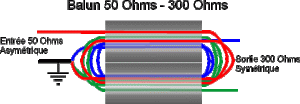
Figure 3 : Le Balun proposé

On commence par faire 2,5 spires (bleu), en partant du coté 300 Ohms. On raccorde l’autre extrémité à la masse, au niveau de la prise d’entrée. Ce sera d’ailleurs le point commun de masse. En partant de la masse, on rebobine à nouveau 2,5 spires de fil (vert) qui aboutira coté 300 ohms. Toujours à partir du point de masse, on rebobine à nouveau 2 spires (rouge) qui aboutira à la prise (PL) d’entrée.

Le diamètre du fil sera choisi de manière à occuper la totalité du tube.

En gardant le même principe, on peut réaliser différentes adaptations en respectant le nombre de spires donné par le tableau suivant :

Adaptation Bleu Vert Rouge
50 / 50 1 1 2
50 / 110 1,5 1,5 2
50 / 200 2 2 2
50 / 300 2,5 2,5 2
50 / 450 3 3 2
50 / 600 3,5 3,5 2
50 / 800 4 4 2

Sur une charge fictive, le TOS que l’on peut relever ne dépasse pas 1,5. Les pertes mesurées sont de 0,4 dB.

Le fil pourra être , suivant la taille soit du fil émaillé, du fil rigide de cablage domestique, du fil souple de cablage industriel.

Exemple de réalisation d’un balun pour antenne de type WINDOM

8 thoughts on “Homebrewing a balun”

  1. Frans says:
    June 3, 2011 at 6:46 am

    How about posting the balun plans in English? Thanx Frans.

  2. harry says:
    September 30, 2011 at 5:11 am

    Hi IW5edi,

    Please send 50/300 ohm balun construction in english, and will it do 1500 watts legal limit ?

    ur email reply will be great !

    tnx, 73,

    Harry.

  3. claus.lauridsen@telia.com says:
    January 6, 2013 at 7:49 pm

    hello simone

    please on english i cant read france

    jour homebrewing balun site interesting

    best regards from sm7nbo

  4. Simone says:
    January 7, 2013 at 12:46 pm

    Hello Guys…
    use google translator for your translation needs

    translate this page
    in your language now

  5. Jorge says:
    January 25, 2013 at 10:49 pm

    Hello:
    I need a contrution 6:1 balun 3000W to work 3,5~30Mhz.
    Please send me a PDF with instrutions to home made.
    Best regards
    Jorge-ct1asm

  6. Jonathan Guthrie says:
    March 15, 2013 at 4:29 pm

    The text reads something like this in English:

    The construction of a balun to go from 50 to 300 ohms for frequencies between 3 and 30 MHz.

    Constructing a balun is pretty easy. Here’s how to make a balun to turn a 50 ohms unbalanced to 300 ohms balanced. It’s done with two tubes of type 43 ferrite. The size of the tubes depends on the power you want to run. In this example, I’m using two Fair-Rite tubes, with an outside diameter of 19mm, an interior diameter of 10.5mm, and a length of 50mm. (Note for the metric impaired: That’s about 3/4 inch outside, 3/8 inch or so inside, and 2 inches long. I don’t think the precise dimensions are critical.)

    This balun requires several coils, three in this case. To illustrate, see figure 2.

    Start with 2.5 turns (shown in blue) from one of the 300 ohm terminals and connect the other end of that to the coax outer shield. This will be the common for the balun. Starting from the ground, wind 2.5 more turns (shown in green) and connect that to the other 300 ohm terminal. Also, wind two turns (shown in red) from the ground and connect that to the coax center conductor. (NOTE: The diagram shows all of the windings being wound in the same direction, which matches information about similar baluns that I’ve seen elsewhere.)

    The wire diameter is chosen to fill the center of the ferrite tube.

    Following the same principle, you can make other impedance transformations by using different numbers of windings, as shown in the table: (NOTE: I won’t reproduce the table, the first number is the unbalanced impedance, the second one is the balanced impedance, the third is the number of turns of blue winding, the number of turns of green winding, and the number of turns of red winding.)

    On a dummy load with an SWR of less than 1.5:1, I measured a loss of 0.4 dB.

    You can use any kind of wire, enamelled, house wiring, or flexible industrial cable.

    Here’s an example of a balun for a Window antenna.

  7. Andrea says:
    September 23, 2015 at 1:19 am

    Caro Simone, prima di tutto ti volio ringrazziare per il tuo supporto nella comunita dei radio amatori. Non so se mi puoi aiutare perfavore. Sto costruendo un yagi multibanda e non posso trovare un schematico di un balun per sollevare la impedance da circa 20 ohms a 50 .. Saro molto grato se mi potrai aiutare.

    Grazzie in anticipo
    Andrea
    9H1TT

  8. Dave says:
    December 21, 2024 at 12:47 am

    Interesting post. Gives me some ideas for using aperture or binocular cores and smaller Cat-5 wire strands for QRP of 20 watts. AD6AE

Leave a Reply

Your email address will not be published. Required fields are marked *

This site uses Akismet to reduce spam. Learn how your comment data is processed.

IW5EDI Simone

  • Licensed Amateur Radio operator in 1996 as IW5EDI, active member of ARI Firenze and ARRL
  • Class 1970, married with two childrens, love experimenting and antenna home-brewing. IT System Engineer, recently started having fun with morse code and Raspberry Pi


IW5EDI Simone


This Blog is mainly dedicated to Amateur Radio (Ham radio) and contains external articles and personal esperiences.

What is Amateur Radio ?
More Ham Radio Links


Blogroll

  • ARI Italian Amateur Radio Society 0
  • ARI Firenze ARI – Sezione di Firenze 0
  • ARRL Amateur Radio Relay League 0
  • DX Zone Ham Radio Internet Guide 0
  • DXSummit 0
  • DXWatch 0
  • eHam 0
  • Ham Radio Daily Ham Radio News 0
  • IW5EDI on QRZ.com My page on QRZ.com 0
  • Long Delayed Echoes 0

My Content

  • Antenna Projects 0
  • RadioAnnunci.it Mercatino Radioamatoriale 0

Categories

  • Articles (131)
    • Antenna Theory (13)
    • DXing (2)
    • How to (10)
    • shortwave (7)
  • Company and Products (1)
  • DXing (13)
    • QSLing (4)
  • Equipment (97)
    • Antenna (65)
    • Software Defined Radio (6)
  • Featured (28)
  • Ham Radio Events (25)
  • Ham Radio News (1)
  • Ham Radio Software (26)
  • HamRadio (94)
    • Ham Radio 2.0 (16)
    • How to (6)
    • Radio Scanning (6)
  • Homebrew (143)
    • HF Antennas (79)
    • Raspberry Pi (1)
    • UHF Antenna (16)
    • VHF Antennas (38)
  • Photos (4)
  • Short News (4)
  • Video (4)

Comments

  • Charles Mintoff on Ham Radio 2012
  • Roger Sparks, W7WKB on Petlowany Antennas by K6NO
  • Frank Barnes on Ameritron AL-80A restoration project
  • ken m3zkb on W5GI Mystery Antenna
  • Bobby on 5/8 Vertical Ground Plane antenna for 10 meters

RSS The DXZone.com

  • Top Amateur Radio Websites - Issue 2603
  • FT2: New Ultra-Fast Digital Mode Tested on HF
  • Top Amateur Radio Websites - Issue 2602
  • The G3LZR Tribander : The charm of the Impossible Antenna
  • Top Amateur Radio Websites - Issue 2601
  • Amateur Radio Clubs
  • DXtreme Monitor Log 14 - Radio Spectrum Monitoring Software
  • Sangean ATS-505 Receiver Review
  • Receiver Review: ICOM IC-R9000
  • Phase Controlled Receiving Array for QRP Low Band Fox Hunting

Ham Radio Blog – IW5EDI Simone JN53OR

© 2026 IW5EDI Simone – Ham-Radio | Powered by Superbs Personal Blog theme