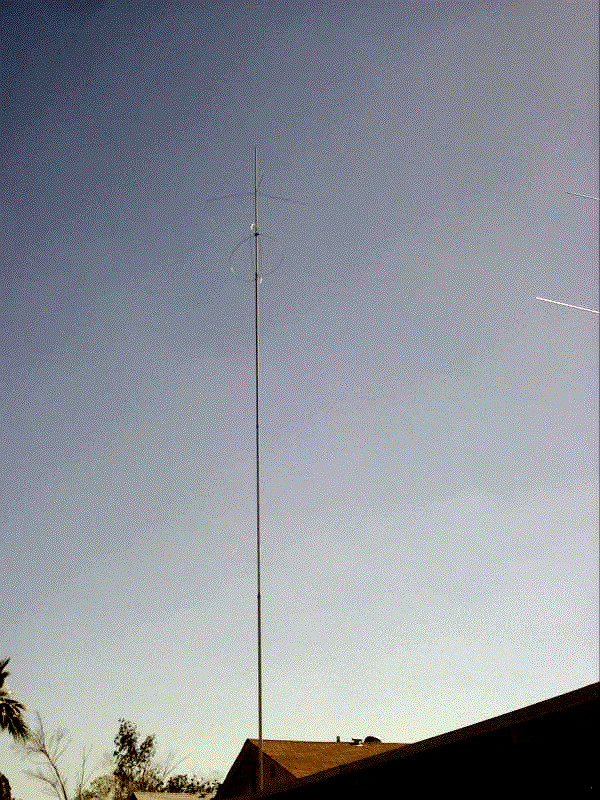
The specifics
Operating range: 7.0 to 7.3 MHz
1.5:1 VSWR bandwidth: greater than 7.0 to 7.3 MHz
Gain (over relatively good ground) @ 7.5ft. above earth: 2.11dBi
Maximum radiation angle (mounted @ 7.5 ft.): 21°
Element height (above mounting bracket): approx 23.75 ft.
The loaded element problem
The reduced VSWR bandwidth in both linear loaded and coil loaded elements is greatly the result of additional reactance being introduced into the element’s electrical characteristics by the loading component(s). Any introduced reactance will augment any feed-point reactance that results from a voltage-to-current ratio imbalance which naturally occurs when an antenna is operated at other than its resonant frequency. In other words, the further off-resonance the antenna is operated, the greater the feed-point reactance becomes, and any introduced reactance from loading components will exacerbate the naturally occurring feed-point reactance which further reduces the usable VSWR bandwidth.
Popular linear loading methods generally fold a conductor from a point near the center of the half-element back into the high current area (towards the feed-point) then forward to the half-element center area again. Not only do the folded-back conductor become two closely spaced parallel conductors, they also run in parallel to the element. The problem is, there is always a value of capacitance between closely spaced parallel conductors. Although the capacitance introduced by this method is distributed along a portion of the element, a bandwidth reducing reactance is introduced nevertheless.
In coil loading, the parallel proximity of the coil’s windings to each other create a lumped capacitance that increases the Q of the element– that which linear loading attempts to mitigate– thus reducing bandwidth. The greater the Q the lower the usable bandwidth. Needless to say, the downfall of either loading method is that some amount of reactance will always be introduced into the element’s electrical characteristics, negatively affecting the usable VSWR bandwidth.
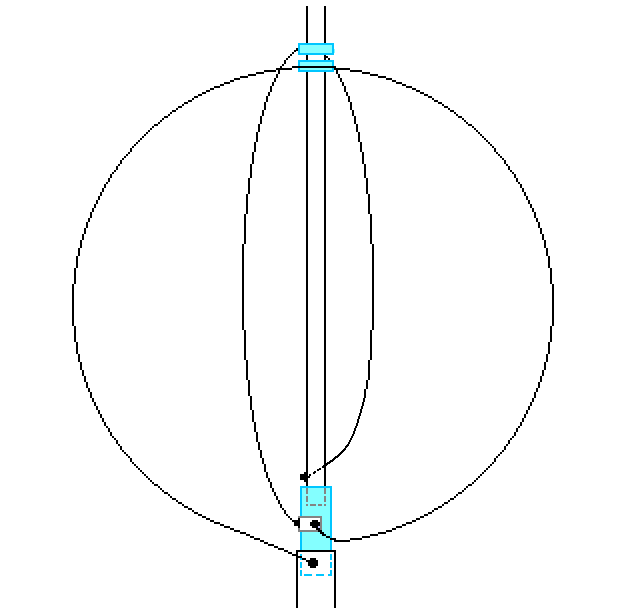
In my attempt to mitigate the introduced reactance problem, I devised this unique loading system which is, more or less, the exact the opposite of the aforementioned linear method, in that the loading device’s conductors proceed forward into the high voltage area, are orientated at 90° angles to the element, and have no parallel conductors, thus introduced capacitance is held to an absolute minimum.
The antenna
My “Loopy” loaded vertical (shown in photo at top) has been in use for about 6 years– through ½ a solar cycle and summer/winter band conditions. What has been most surprising about this loading method was that the usable VSWR bandwidth on 40m was better than I had anticipated– being as good as, or perhaps better than, any of the full-sized 40m verticals I’ve built in the past– which suggests perhaps, that this loading method may be reducing to some degree, the off-resonance reactance at the feed-point, thus increasing the overall usable VSWR bandwidth rather than decreasing it as other loading methods do.
Given that all joints and connections have been periodically tested and found to have no effective DC resistance, and all local and DX signal reports have been very consistent with that of a 40m ¼ wavelength elevated ground-plane vertical, it seems reasonable to assume that the wide VSWR bandwidth is not a product of resistance or ground losses.
The antenna is mounted above the earth by approx. 7.5 ft., with three 34 ft. elevated ground radials running parallel to the ground (1 radial is bent into three sides of a square to accommodate property boundaries) that are attached to the mounting bracket at the Gnd/GR tie point shown in the “Mounting bracket detail” drawing.
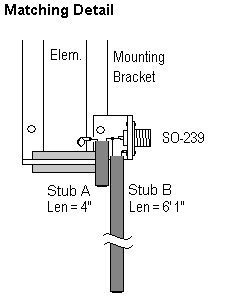 Feeding
The antenna feed-point is located at the bottom of the element (support tubing) where a somewhat unconventional matching transformer, consisting of a 4″ long 300 ohm twin-lead shorted stub (A) in series with the feed-point, and a 6′ 1″ long 300 ohm twin-lead shorted stub (B) shunted across the coaxial input connector, is used to transform the input impedance to ± 50 ohms.
Th e feed is attached to the feed-point using a self-tapping screw through a perforated solder-lug, to which one of the series matching stub wires is soldered. The other wire of the series matching stub is soldered to the coaxial connector’s center conductor solder lug, to which one of the shunt matching stub wires is also soldered. The remaining shunt stub wire is soldered to a perforated solder-lug that is grounded to the body of the coaxial connector by one of its mounting screws.
The SO-239 coaxial input connector is mounted on an aluminum L bracket that is secured and grounded to the antenna’s mounting bracket as shown below.
Best results were realized when the coaxial TX-line was tightly wound into a 10 turn choke-coil adjacent to its antenna connector to decouple its shield from the antenna and reduce common-mode current radiation. Several ferrite chokes mounted in series on the TX line would also be effective in this regard. Both methods are used on the TX line here.
Update
Apparently, the proximity (25 ft.) of my 45 ft. tower is influencing the feed point impedance of the vertical to some degree, thus my need for the series stub (A) in the matching network. It seems not necessary in most other environments. Others who have built this antenna in an open environment report the need of only Stub B, at a length of approximately 5′ 5″.
Computer Modeling
Computer modeling suggests the gain of this antenna is consistent with that of a full sized ¼ wavelength ground plane. You can click on the link below to see these results. They illustrate the Elevation radiation pattern of this antenna. One model is over a perfect ground and one is over ground conditions that closely approximates my QTH. The models utilize four ¼ wavelength radials with the radials and antennas elevated 7.5ft. above
The antenna dimensions

Loading loop and insulator details
The mounting bracket
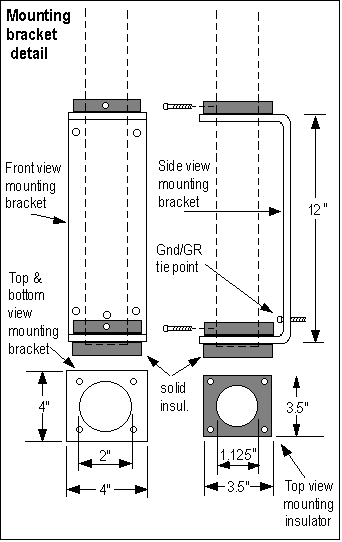
The mounting bracket shown here is made from a 3/16″ x 20½” x 4″ piece of 6061-T6 aluminum plate, bent as shown. There are three 3.5″ square insulators that are made of 3/8″ high UV resistant PVC (dark gray) flat stock. All three insulators have screw holes drilled in each corner that match the screw holes in the top and bottom of the mounting bracket (See Mounting Bracket detail) and two have a 1.125″ hole in its center to hold the internal support tubing which rests on the solid insulator at the bottom.
The vertical element is mounted by inserting the 1.125″ section of the support tubing into the insulators (shown above as dotted lines) and securing it in place with screws through the insulator sides as shown in the Mounting bracket detail. The bottom of section [A] of the assembled antenna is then slid over the support tubing, coming to rest on the top mounting insulator, then secured with a tubing clamp.
The 4 holes shown in each corner of the vertical portion of the mounting bracket are for U-bolts so the antenna can be mounted on a support mast.
Parts
The main element insulator is a 1″ OD x .625″ ID x 6″ length of Garolite (CE) tubing.
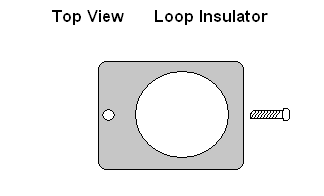
Each of the loop insulators are 1″ x 1.375″ x 3/8″ and are made of high UV resistant PVC. Each have a .625″ hole, drilled off-center, to allow the element to pass through. A set-screw through their thinner side is used to hold them in place on the element, and a small vertical hole was drilled through their thicker portions to accommodate a tie-strap for securing each loop to its insulator.
Each loading loop is made using an 8 ft. length of #8 aluminum wire.
The four (4) top-hat radials are each 24 in. #8 aluminum wire.
Element section [A] is an 6 ft length of 1.5 in. .058 wall 6061-T6 or 6063-T832 aluminum tubing.
Element section [B] is a 6 ft length of 1.25 in. .058 wall 6061-T6 or 6063-T832 aluminum tubing.
Element section [C] is a 6 ft length of 1 in. .058 wall 6061-T6 or 6063-T832 aluminum tubing.
NOTE: Sections B and C are telescoped 3″ into sections A and B respectively.
Copyright By S. C. Chuck . Smith First publish: Oct. 11. 2006
Element section [D] is a 4 ft length of .625 in. .058 wall 6061-T6 or 6063-T832 aluminum tubing.
Element section [E] is a 4 ft length of .5 in. .058 or .042 wall 6061-T6 or 6063-T832 aluminum tubing. Typical extension length should be around 35″ or so.
The element support tubing (as shown in the mounting bracket as dotted lines) is a 3½ ft. x 1.125 in. OD, thick-wall (.25) length of 6061-T6 aluminum tubing.
A 6½ ft. length of 300 ohm twin lead transmission line.
Article Copyright By S. C. Chuck Smith,First publish: Oct. 11. 2006
Originally available at http://www.raibeam.com/wa7rai/40m_vert.html