
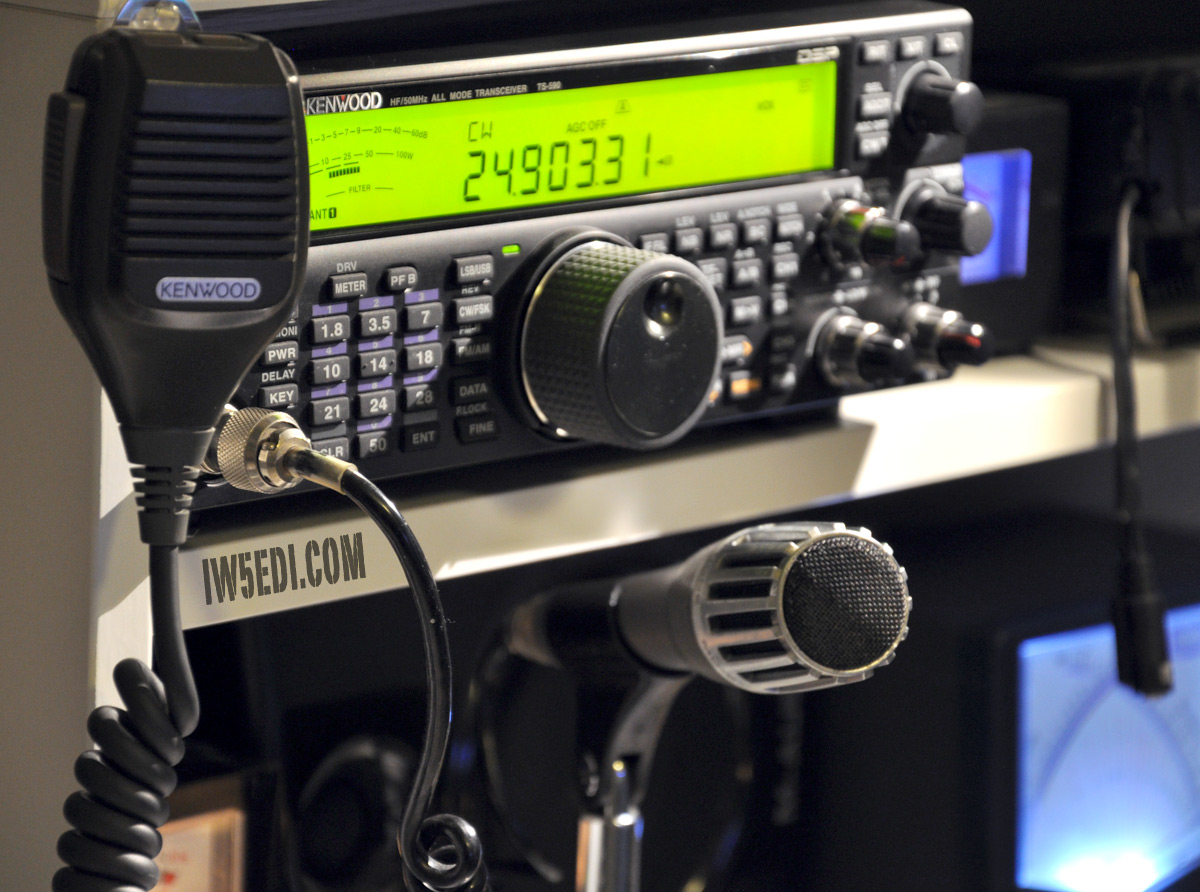
TS-590 the K3 killer …. ???
It could be possible, but to demonstrate who is the killer we need facts and features palpable, not noise. I would like to explain my point of view on the above subject. Please excuse me if I may sound “aggressive†but we have to put light on same specific points to make real comparisons. K3 does not need a violin fiddler…
For a comparison we do need tests that can avoid personal interest or love … First test could be the comparison of TS590 and K3 circuit diagram, looking at the receiver path, although we should look at the TX area for reduction of spuries emitted. Second test, an independent review like the ones made by Peter Hart, G3SJX, and published in RadCom (RSGB). Peter is a gentleman and does not usually “offend†the manufacturers but reports his reviews quite clearly, although he does not write as much as he was doing in the past century. If you look properly at Peter’s measurement tables, you will understand the quality of equipments from the “measurements†point of you. K3 Review has been already published with good reports, see RadCom July 2008.
Third test, have a couple of contest users, the ones that do scores, with bended eyes, operating the two equipment, being swapped by external judges, during an SSB and a CW international contest, maybe on 40 and 80 meters. Here we have the real “ear test†that is what it really counts. It is possible that Kenwood may have produced a real K3 killer, if they have well studied the K3. I will be critical here to help an owner or a buyer of both equipment to understand where change of performances could be located (improvement by Kenwood)
PROBABLY I AM COMPLETELY WRONG …
other friends may explain better than me the PRO and CON guessed till real data and information will be available. Let see my guessing:
First Mixer
K3 employs a switched mixer using a Fast Bus Switch but it is not an H-Mode Mixer. It is the classic Ed Oxner double balanced mixer from the 70s with an FST in place of JFET or MOS. TS590 may employ a similar mixer, if not using FST it may use JFET or MOS. At this point there should not much differences IF Xtal BP Filter K3 uses a homebrew like ladder filter. Selectivity and symmetric curve is not published. Quality INRAD Filters (same as in the FT1000xx) are available and they should make some difference. TS590 may use a classic filter with better selectivity and symmetric curve.
RF and IF amplifiers
K3 amplifiers are not too impressive in performances, but they are not bad. TS590 may have the IF stages more performing in noise and linearity.
Image Noise Filter
K3 has an image noise filter (2 xtals – BW 14kHz) to reduce noise generated by the IF amplifier entering the second mixer. TS590 may not has it.
Second Mixer
K3 employs an SA612 mixer chip. I believe this is the most critical stage. The SA612 has a stage gain around 18/20 dB and an IP3 around -15dBm. It means that
if two strong signal passing through the IF filter reach this stage they will generate important intermodulation, we hope it will be “handled†by the DSP with software BPF and Notches. TS590 may have a better mixer, classic diode or switched DBM, maybe I-Q. Here Kenwood may have a big benefit, plus valid side band attenuation if I-Q. With a passive mixer, the gain distribution will have to be reviewed, requiring better amplifier stages and screening.
DSP
K3 has high performing DSP, where KK7P involvement is a guarantee of quality and performance TS590 may have the latest IC technology but may be poor on the software side to give performing functionalities.
Synthesizer
K3 has a DDS plus a PLL to have low number of spurs and a not too bad phase noise. TS590 may have something similar or only a DDS. Here we will have a very low phase noise but probably several disturbing spurs.
Second RX
K3 has the option for a second receiver TS590 it looks like has only a single receiver. At this point we have a question: How many users will be interested or in bad need of a second receiver? I could not care less for a second receiver… but for a DX cheasers or Contestmen it would be an important feature.
There are two additional aspects that we have to think of:
1)Â TS590 price versus K3
2) For non USA customers a local service center support will make a difference as Elecraft has only a return service to USA or swapping parts service. I am sure Elecraft has a better technical support than Kenwood. I am not an equipment purchaser, unless I do get it for a really good price. I like to modify equipment to improve performances … maybe I am OK for a gift … hi. I try my best not to be “married†with any specific manufacturer…. I am an homebrewer (supposed to be…hi). I hope you do appreciate my notes written not to put in bad light the K3 nor to put in better light the TS590. My notes are to help the to be purchasers, reseller (on e-bay …hi) or users to open their own eyes when discussing about equipment comparison. When asked by any Ham, about which is the best equipment to buy, I always say:
“Buying an equipment is like getting married … never listen to friends, relatives and gurus select a wife … one is alone in this important step ! One should purchase the equipment that sound better to himself and it is matching own operating and poketâ€.
Thanks to Elecraft for hospitality and for your attention.
Best 73
Gian
I7SWX
Hello Simone,
I started to write a reply to your opinion and it got so long I decided to make it a blog post 🙂 :
http://yo9irf.blogspot.com/2015/01/about-elecraft-k3-vs-kenwood-ts-590.html
Please let me know what you think.
Razvan YO9IRF