Yaesu FT 1000 Review by W4TI
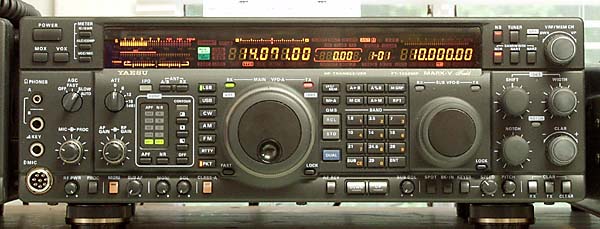
I am way too cheap for this radio!
I am far too cheap to ever pay this much for a radio. The Yaesu FT-1000MP Mark V Field is really out of my price class. I have always had middle-of-the-road kinds of radios, until I bought this one. There is a reason for this one, though, and why it is that in this one case, I bought the best radio I could find. My dad passed away at age 80, in May of 2002, and left my sister Julie and me whatever he had. My Auntie JoAnn told me her theory, that when someone dies and leaves you some money, that you should find one thing that you have really wanted for a long time, and buy that one thing, and use it to remember that person. After some thought, I consulted with my Beloved Wife Monica (N6PSD), and did just exactly that. I bought one top-of-the-line amateur radio transceiver with all of the bells and whistles, and think fondly of my dad every time I use the radio. He was never an amateur radio operator, although when I was a teenager, he aided and abetted my becoming one. So, thanks, Dad! I really like the radio you bought me!
How this radio is configured.
This particular sample of the Yaesu FT-1000MP Mark V Field has every possible IF filter installed, along with the matching MD-100 microphone, SP-8 speaker and LL-7 phone patch. The filters are the original ones from Yaesu, as opposed to after-market units. I have strongly considered installing the roofing filter kit from International Radio, but have not done so yet. Other than the above, it is a stock radio, as it comes from the factory.
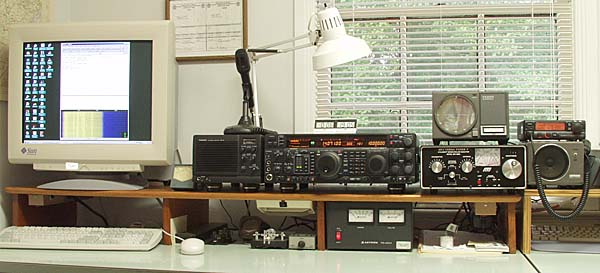
Features I really like:
Full Break-In CW (QSK) – The Yaesu FT-1000MP Mark V Field is a CW operator’s dream come true. The full break-in is so good that when I send, it is as if the receiver never goes away at all. I hear my signal in the midst of all of the other signals on the band. Over the years, I have attempted QSK operation with several radios, but this is the first one where it works perfectly, with no shortcomings as far as I can see.
Excellent Front Panel Layout – The Yaesu FT-1000MP Mark V Field is a large radio, with ample room on the front panel for every useful control at my fingertips. The controls are well-organized, with related controls grouped in clusters, making managing the radio a simple matter. Unlike so many modern radios, none of the regularly used controls are buried in menus. Everything I use during operation is controlled by the front panel.
Dual Simultaneous Receive – The ability to listen in two places at once is a great asset. It can do this and listen on different bands at the same time, so it is possible to listen for a band opening on one receiver while operating on another band. For split operation, it is possible to hear both the receive and transmit frequencies, so that in a pile-up I can hear both the DX station and the crowd, and be able to hear where the DX is listening. I have had several radios which would operate split before, but this is the first one which allows the ability to listen two places at once. Furthermore, with stereo headphones, it can be set up to spatially separate the two receivers, with one on the left and the other on the right. The two receivers can be set to have different bandwidths or even modes. This is very slick indeed.
Excellent Selectivity and Control – This particular Yaesu FT-1000MP Mark V Field has every possible filter installed, and the selectivity and adjacent-signal rejection are truly top-notch. The main receiver has two filters (mechanical or crystal filters) for each selectable bandwidth, which gives excellent steep skirts and very high rejection of off-frequency signals. The filters installed have nominal bandwidths of 2.4 KHz, 2.0 KHz, 500 Hz, and 250 Hz. This by itself is wonderful. However, by using the “Shift†and “Width†controls it is possible to move the centers of the first and second filters relative to each other, allowing an even narrower bandwidth to be achieved. But wait, there’s more! Using the “IDBT†feature, I can tell the radio to automatically set the DSP to track the settings of the Bandwidth, Shift, and Width controls to further isolate the signals I want from the rest. If there is an interfering carrier, there is an automatic notch filter which will make it virtually disappear. There are probably more features one could add to a radio receiver, but this combination is absolutely excellent.
Absolute Frequency Stability – I did not purchase the extra high stability reference oscillator for this radio because, quite frankly, it didn’t need one. The stability and frequency accuracy are good enough that I cannot detect any error or drift, measuring against WWV. It is always just right-on.
Easy-to-Understand Controls – I have used many radios over the years, and have come to like the “big rig†models. For a while I had a Yaesu FT-817, and it was supremely cute. The only real issue I had with it was that many of the functions I regularly used were buried in menus, making it difficult to use without having the manual right there. Recently, at Field Day, I found myself using another ham’s Yaesu FT-847, and I was lost as to how to get it to do certain things. Once again, regular operational features were controlled by menus, and I had never used this radio before, and could not get it to do what I needed. By comparison, all of the regularly used functions on the Yaesu FT-1000MP Mark V Field are controlled by front panel buttons and knobs, and well-designed ones at that. It is a lot easier for me to use. Furthermore, the buttons and knobs are large enough for my (large) hands to operate without inadvertently hitting other functions as well. This is a Very Good Thing.
Rear-Panel Connections for Every Mode – Yaesu has supplied input and output jacks for most any mode one could want. For instance, for the use of PSK-31, I attach the interface to the computer through the “Packet†port on the rear of the radio. The Yaesu FT-1000MP Mark V Field is set up to automatically disable not only the microphone, but also other audio inputs when the packet mode is selected. The audio output to the “Packet†port is a constant level, and not controlled by the AF agin control, so that it is possible to operate PSK-31 and either listen to the audio or not, at one’s own choice. The interfaces are very well thought out.
DSP That Works – Yaesu has put a lot of thought into the DSP system included in the FT-1000MP Mark V Field. The changeover from the original FT-1000MP to the Mark V series marked a real improvement in the control of the DSP, and the automatic linking of both the IF filters and the DSP operation. I find it amazing to engage the EDSP Noise Reduction, and hear the signal just stand right out from the noise. I am certain that improvements will be made to this sort of functionality in the years to come, but this design is so capable that it is truly amazing. This radio has a great receiver.
Built-In Power Supply – Plus External 12V Input – I like having a self-contained radio system. Ever since I bought my first TS-520 (more than 30 years ago) I have enjoyed having the power supply built-in. It makes taking the radio places so much easier, knowing that I can just plug it in. In this case, though, the Field model also has an input jack for 12 VDC, so that the radio can be used directly from an automotive battery. For me, this is a necessity. Emergency operations frequently do not provide 120/240 VAC, and even many of the radios with internal power supplies do not allow the user to bypass the internal supply and operate the radio from 12 VDC. This one does.
Quiet But Effective Cooling – the Yaesu FT-1000MP Mark V Field has a huge internal heat sink, and a cooling fan which is thermostatically controlled. It is very quiet, to the point where I have had to turn the AF gain all the way down, and put my ear next to the radio to determine if the fan was running. It runs when the radio warms up, and not just when the transmitter is operating. During the summer months it gets hot here in Alabama, and the fan cycles as required to keep the radio cool and safe.
Excellent Transmit Audio – How did you want the transmit audio to sound? The Yaesu FT-1000MP Mark V Field provides the capability to choose whether to use analog or DSP signal generation, and then to tune the entire set of transmit signal characteristics to match the user’s voice and operating style. In addition, there is IF speech processing, which can be set to significantly compress the transmitted signal, while maintaining a narrow transmitted bandwidth. I have a friend who wanted the most potent pile-up busting extra-dense audio, and set his Field up to do exactly that. I choose to use a more moderate amount of processing, in order to sound more like me. With this radio, you can set it to do what you want.
Features I don’t like:
Built-In CW Keyer – I find that the built-in CW keyer is “fussy” concerning hand timing, and that I have not been able to adapt to it. Furthermore, the speed knob is tiny, and covers a very wide range of speed. I suspect that the keyer is just another function of a very busy microprocessor, and that its timing varies a bit from time to time depending on what else the radio is doing. I have the FH-1 remote control keypad which allows use of the internal keyer for contests and the like, with canned messages and incrementing serial numbers and such. It works well, all except for the hand timing. I solved the problem by purchasing an Idiom Press Logikey K-5 keyer, which is feels right, and has about every feature that a serious CW operator could ever want. Considering how expensive the FH-1 is, an external keyer is a better deal anyway.
Summary
There are more features to speak of, but this is enough for now. Would I buy this radio again? Oh, yes! I intend to keep it and use it for many years, as it does exactly what I want, and does it very well.