Skip to content

IW5EDI Simone – Ham-Radio

Amateur Radio made in Italy

Menu
  • About me
    • QSL info
    • Log Book OnLine
    • What I Hear
    • Live Stream
    • Perchè (Why) in English ?
    • Contact me
    • Privacy info
  • Software
    • Ham Radio Deluxe 5.2
    • IP-Sound
    • OscillometerXZ
    • YO Yagi Optimizer
    • HamAlyzer 2.8
    • ERP Calculator
    • 59+ software
    • Magnetic Loop Calculator
    • MeterMate
    • UDY 2 Voice Keyer
  • Ham Radio
    • Beginners Guide to Ham Radio
    • Direct QSLing from Italy
    • Foreign Ham Operations in Italy
    • Tourist Ham Radio in Italy
    • Frequency List
    • Metric Conversion Table
    • Sound Card Interfacing for RTTY, PSK31, and SSTV
  • Technical Articles
    • Microphone Connections
    • A low cost 600 watt ultra-linear amplifier
    • VE7AVV – YAESU FL-2100Z Amplifier Repairs
    • Mic Wiring – Ham Radio
    • Homebrewing a balun
    • Grounding Concepts
    • HF Scanning frequencies
    • Wi-FI: Measuring network throughput
    • Determining RFI problems in mobile
    • Hidden and stealth antennas
  • Antennas
    • 144 / 430 Dual Band J-pole antenna
    • 10 Meter 4 Element Quad Antenna
    • 144 Mhz Magnetic Loop Antenna
    • A “loopy” Loop Loaded Vertical
    • W5GI Mystery Antenna
    • A Multiband Dipole
    • Build a W3DZZ Antenna
    • A portable 2-element VHF yagi
    • Assembling GAP Titan DX Antenna
    • The Galaxy Dipole
    • Pfeiffer Maltese Quad Antenna System
    • Magic Anti-Jamming antenna
    • D3+ High Performance Antennas
    • EH Antenna for 40 and 20 meters
    • Homebrew G5RV
    • 40 meter mini Moxon Antenna
    • EH Antenna for 10 meter
    • Quad and ModQuad Antenna
    • Inverted U antenna for 160 meters
    • 6 Band HF Windom antenna
    • The Bazooka Antenna
    • Antennas for HF mobile operation
    • Inverted L Antenna for Low Bands
    • Your first dipole
    • Remote control Antenna Switch
    • The gin pole
    • Hexbeam antenna setup
    • W4TI Rotor Installation
Menu

Quad and ModQuad Antenna

Here’s some thoughts on a “hardware-store special” 2-meter quad, and a modified quad for 2 or 10 meters. You can convert these to other frequencies simply by scaleing all dimensions according to wavelength. That is, to put the 10-meter modquad on 15 meters, just multiply all dimensions by 29.0 / 21.25.


A standard 2-meter quad

Buy some 1/2″ CPVC plumbing hardware from your local hardware store. Or, e-mail us: we can supply all these pieces, cut to length: ask for prices. Here’s the list of plastic you will need:
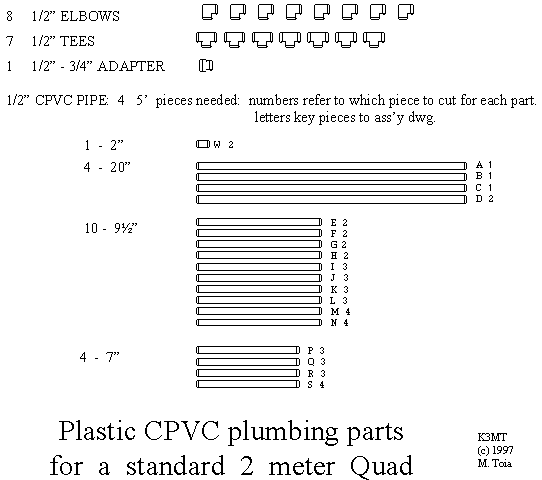
partlist


Four 10′ pieces of 1/2″ pipe are needed: cut the parts from pieces 1, 2, 3, and 4 as shown in the diagram. Next, assemble the reflector and driven element loops. Thread a piece of #18 (or so) magnet or hookup wire through each loop frame as you make it up, like this:
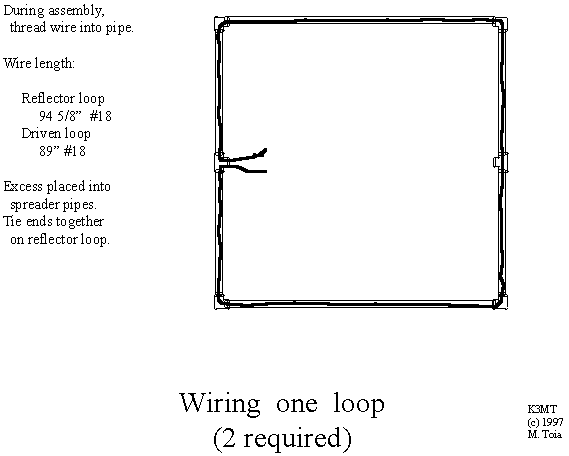
 

loopwire


Oh, yes – consult the assembly drawing to see which pieces of cut pipe to use in each loop. Note that the two loops are the same size!
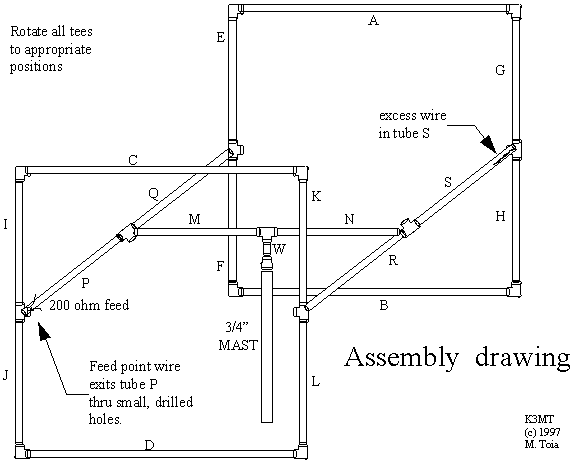
assy

The front loop in this drawing is the driven loop: the rear loop is the reflector. Note how excess length of reflector wire is twisted together (fairly tightly) and threaded into the spreader pipe S. The degree of tightness of this twist determines the front to back ratio or the maximum gain: this is how you tune the quad.

The quad shown has a feed impedance of about 200 ohms. You can match it with any 4:1 balun to take it to 50 ohms. This is a simple cable balun made from coax that does the job:
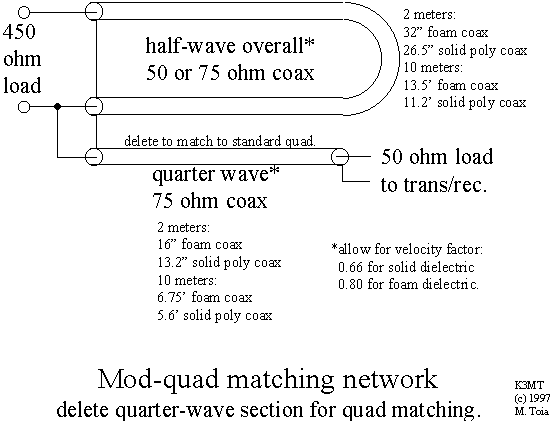
 

balun


Note that the quarter-wave 75 ohm section is not used for the standard quad. More on this in just a minute.


The “ModQuad”

Now for a variation on the quad theme. Did you ever consider bending the loops a bit to make a self-guyed antenna? Look at this diagram – see if you can pick out the “bent” reflector and fed loops.
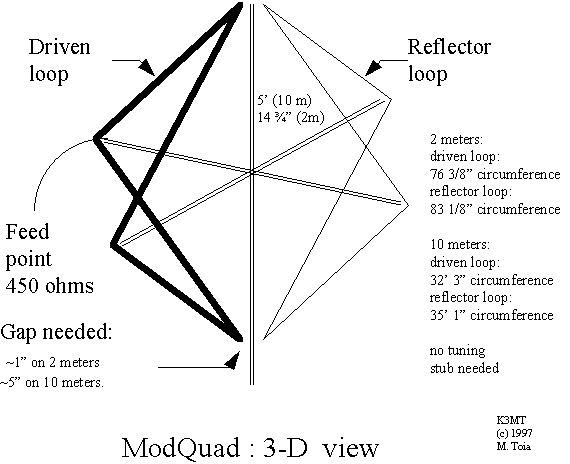
modquad

Notice that this antenna has two horizontal spreader poles, at right angles, and a vertical mast. The loops do not go from one spreader, over the top, and to the other end of the same spreader!! A loop goes from one spreader, to the top, and to an end of the other spreader.

The feed point is at the end of one spreader. No tuning stub is needed: the antenna wire has been lengthened to take up all the stub wire.

SOME NOTES ON THE MOD QUAD


  • The ModQuad as shown is vertically polarized.
  • Its directivity is from the center of the reflector loop, through the center of the driven loop.
  • Adding a girdle line (not shown) around the four ends of the horizontal spreaders will add significanly to mechanical stability.
  • The input impedance of the ModQuad is 450 ohms
  • The gain of the ModQuad is about a half dB or 1 dB less than a standard quad.

So why would you ever want to use a ModQuad? The answer is simple: when you want to replace a quad that keeps blowing down! Notice that it has only two spreader poles, and is somewhat simpler than a standard quad. You decide -I’m only presenting you with some ideas.


Some final comments

A ModQuad for 10 meters has been used at K3MT since its first construction in January of 1997. It’s April now – the antenna has done yeoman service so far, but it’s too early to tell if it really stays up in a heavy storm. I’ll add a post-mortem, or update, here from time to time. (Oh,yes – even though the SSN is in the doldrums, the Vienna Wireless Society has two active ten meter nets nightly. That’s why the ModQuad is used.)

I’ve been modeling quads using some neat software (NEC-2 and NEC-4). Modeling seems to show that a standard (or modified) quad can be re-tuned and will work well anywhere over a 2:1 frequency range. Check my home page for developments, after I’ve been able to verify this on the antenna range.

Article copyright K3MT originally available at this link

Leave a Reply

Your email address will not be published. Required fields are marked *

This site uses Akismet to reduce spam. Learn how your comment data is processed.

IW5EDI Simone

  • Licensed Amateur Radio operator in 1996 as IW5EDI, active member of ARI Firenze and ARRL
  • Class 1970, married with two childrens, love experimenting and antenna home-brewing. IT System Engineer, recently started having fun with morse code and Raspberry Pi


IW5EDI Simone


This Blog is mainly dedicated to Amateur Radio (Ham radio) and contains external articles and personal esperiences.

What is Amateur Radio ?
More Ham Radio Links


Blogroll

  • ARI Italian Amateur Radio Society 0
  • ARI Firenze ARI – Sezione di Firenze 0
  • ARRL Amateur Radio Relay League 0
  • DX Zone Ham Radio Internet Guide 0
  • DXSummit 0
  • DXWatch 0
  • eHam 0
  • Ham Radio Daily Ham Radio News 0
  • IW5EDI on QRZ.com My page on QRZ.com 0
  • Long Delayed Echoes 0

My Content

  • Antenna Projects 0
  • RadioAnnunci.it Mercatino Radioamatoriale 0

Categories

  • Articles (131)
    • Antenna Theory (13)
    • DXing (2)
    • How to (10)
    • shortwave (7)
  • Company and Products (1)
  • DXing (13)
    • QSLing (4)
  • Equipment (97)
    • Antenna (65)
    • Software Defined Radio (6)
  • Featured (28)
  • Ham Radio Events (25)
  • Ham Radio News (1)
  • Ham Radio Software (26)
  • HamRadio (94)
    • Ham Radio 2.0 (16)
    • How to (6)
    • Radio Scanning (6)
  • Homebrew (143)
    • HF Antennas (79)
    • Raspberry Pi (1)
    • UHF Antenna (16)
    • VHF Antennas (38)
  • Photos (4)
  • Short News (4)
  • Video (4)

Comments

  • Charles Mintoff on Ham Radio 2012
  • Roger Sparks, W7WKB on Petlowany Antennas by K6NO
  • Frank Barnes on Ameritron AL-80A restoration project
  • ken m3zkb on W5GI Mystery Antenna
  • Bobby on 5/8 Vertical Ground Plane antenna for 10 meters

RSS The DXZone.com

  • Top Amateur Radio Websites - Issue 2603
  • FT2: New Ultra-Fast Digital Mode Tested on HF
  • Top Amateur Radio Websites - Issue 2602
  • The G3LZR Tribander : The charm of the Impossible Antenna
  • Top Amateur Radio Websites - Issue 2601
  • Amateur Radio Clubs
  • Sangean ATS-505 Receiver Review
  • Receiver Review: ICOM IC-R9000
  • Phase Controlled Receiving Array for QRP Low Band Fox Hunting
  • Another GM3OXX OXO Transmitter Build by AA7EE

Ham Radio Blog – IW5EDI Simone JN53OR

© 2026 IW5EDI Simone – Ham-Radio | Powered by Superbs Personal Blog theme