Article by N9RET
THE INDOOR SPIRAL DIPOLE
Since well before getting my ham ticket in 1993, I had been interested in maximizing my antenna advantage within the limitations of my small living space. I would experiment with different arrangements for SWL, Scanner, AM/FM/TV and 11m antennas, mostly within the cramped confines of the attic of the efficient row house I grew up in.
THE CHALLENGE
Getting the best reception on my old Realistic DX-160 was challenging, to say the least. Ditto my scanner, TV, etc. Early on I put a VHF/UHF TV antenna up in the attic, fed with 300-ohm twinlead. Of course, back then, I’d just twist the two wires together at the radio end and twist it around whatever stub of an antenna was left protruding from the receiver of choice.
Even so, I noticed a difference, and from there I was hooked. I had to figure out the best combination I could possibly fit in the attic. I tried things randomly and without much success, until that fateful day in 1993 when I found out a co-worker was a ham. He clued me to the fact that there was no longer a code requirement for the entry-level ticket, and even got me the test prep materials.
Little did he know the beast he unleashed that day!
THE EPIPHANY
After finally embracing my inner Radio Geek, I committed to get my No-Code Tech ticket, thanks in no small part to my friend and elmer KC, kg9jp. In many ways, KC made this beacon station possible, even selling me the TenTec at a budget-friendly price to get me started on HF.
I soon became possessed with the desire to learn the code and upgrade my ticket, and the pursuit of this knowledge brought two things into focus; HF Beacons and Antenna Theory.
The beacons gave me the chance to practice my code reception in real-world conditions, and let me compare the effectiveness/directionality of different antenna arangements. It was a big kick to log a far-away new beacon, and a bigger kick to learn how little power they ran to make the distance! Suddenly, a beacon seemed do-able even at my little shack…
I also learned that a complex outdoor antenna array atop a high tower was NOT necessary to communicate effectively over vast distances (it sure doesn’t hurt, though!). It seemed that, with the aid of an antenna tuner and the proper feedline, you could basically just toss up a hank of wire and start making QSO’s!
Needless to say, I got my hands on a tuner and some good-quality 450-ohm ladder line, copped a LOOONG roll of thin 2-conductor wire and some wood-screw type feedline standoffs and crawled up into the cobwebs to try to put up the most wire possible in an orderly manner in the attic.
THE SOLUTION
Many approaches were tried, but what ultimately worked the best is what I now call the Indoor Spiral Dipole antenna. The success that I met with after setting things up this way made it clear that this was a working approach to the problem. The thing tuned up from DC to Daylight (well, maybe that’s a bit of an exaggeration, but 10-80m is no problem) and made QSO’s as soon as I got down from the attic!
I was able to route the feedline discreetly down to my basement shack, and I never heard a thing from the neighbors regarding TVI! Granted, I run QRP power levels mostly, but I have run it at Full Throttle from the TenTec (maybe 70 watts at that time) without starting the microwave oven or causing the neighbors to run screaming into the street…
I posted a write-up about the antenna on the ARRL BBS way back when, and it still exists in their archives (Click Here to see it on the ARRL server). In case they eventually purge it from their servers, I will re-post it here as well.
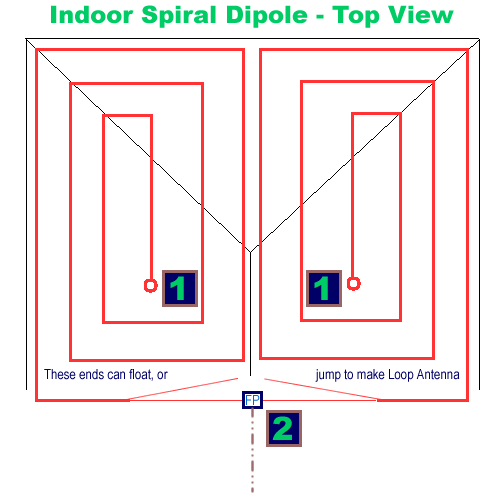
Remember, this antenna uses two-conductor wire (like speaker wire), and one leg is seperated from the other for about four feet at the feedpoint. One of the seperated conductors ties in to the feedpoint attachment with the 450-ohm feedline, while the other “floater” conductor (now the long end of the antenna since we soldered together the ends at #1) can float as it would if it were an ordinary dipole, or we can jumper the ends together, making a long loop antenna.
The feedpoint (#2) is high up in the attic, while the floaters are at floor level. Run the 450-ohm feedline away from the antenna as perpendicular/vertical as possible (although mine runs horizontally along the floor of the attic for several feet before descending into the house).
THE ARTICLE
Subject: Indoor antennas for HF
From: Tim, N9RET
To: All
Date: 01/24/97
This originated as a response to an inquiry about indoor antennas posted on the AES BBS 01/04/97. I have recreated it here for those in similar “postage stamp” size lots who would like to experiment with indoor wire antennas, and use some otherwise wasted space in their homes
As regards your indoor antenna- I am in a very similar situation, and my solution was to construct what I call a “Spiral Dipole” in my attic.
The basic concept is this; starting at the center of the attic at floor level, I hung two runs of 2-conductor wire from the roof joists, using wood screw type standoffs designed for 300-ohm twinlead (available from Radio Shack).
I spiraled each leg of the dipole up and in, using the 16″ on-center joists to maintain consistent spacing. When I reached the end of the spiral, I soldered the two attached conductors together, effectively doubling the length of each leg.
At the feedpoint, I used only one of the two attached conductors from each leg, feeding the array with 450-ohm twinlead ladder line to a tuner. The other conductor from each leg (closest to the feedpoint) is generally left floating, although I have experimented with connecting the two floating ends together, creating a loop-type antenna, with some success (apparent directional characteristics, etc.).
This antenna tunes up from DC to Daylight very nicely, and my first QRP contacts were well into South America. It also works well as a “Lowfer” reciever for the LW beacon band and (to some extent) the MW broadcast band (although it tends to overload my reciever at MW).
I have noticed some directional characteristics even when running it as a dipole (ends left floating), but until I figure a way to rotate the house,I’ll just have to live with the pattern.
***Keep all the flammable junk that tends to collect in an attic well away from any part of this set-up, and as an added measure, run as little power as you can get away with. I installed a smoke detector up in my attic, just to be sure.
I have a small corner townhouse, and I was able to make each leg of this antenna 115 feet long (twice that if you count the doubling of the two-conductor wire at the end of each leg). I am not sure of the principals at work here, but the darn thing works- often better than the ground-mounted 5-band vertical in my backyard!
If you have any further questions about this array, drop me a letter and I’ll include a pictoral diagram of the antenna- it’s neat, out of the way, and it works!
Good luck and happy DX’ing de N9RET!
Article originally available at http://n9ret.10mbeacons.com/isd.html
Hi i have a VXI-3570A VHF/UHF DSP RECEIVER all set up as it was used with all of its components with a vxi case complete unit… just wondering if I have any hope in finding 3rd party software and drivers to operate this receiver
I would love to see a picture of your installation in the attic. — Doug, NT7IM