Skip to content

IW5EDI Simone – Ham-Radio

Amateur Radio made in Italy

Menu
  • About me
    • QSL info
    • Log Book OnLine
    • What I Hear
    • Live Stream
    • Perchè (Why) in English ?
    • Contact me
    • Privacy info
  • Software
    • Ham Radio Deluxe 5.2
    • IP-Sound
    • OscillometerXZ
    • YO Yagi Optimizer
    • HamAlyzer 2.8
    • ERP Calculator
    • 59+ software
    • Magnetic Loop Calculator
    • MeterMate
    • UDY 2 Voice Keyer
  • Ham Radio
    • Beginners Guide to Ham Radio
    • Direct QSLing from Italy
    • Foreign Ham Operations in Italy
    • Tourist Ham Radio in Italy
    • Frequency List
    • Metric Conversion Table
    • Sound Card Interfacing for RTTY, PSK31, and SSTV
  • Technical Articles
    • Microphone Connections
    • A low cost 600 watt ultra-linear amplifier
    • VE7AVV – YAESU FL-2100Z Amplifier Repairs
    • Mic Wiring – Ham Radio
    • Homebrewing a balun
    • Grounding Concepts
    • HF Scanning frequencies
    • Wi-FI: Measuring network throughput
    • Determining RFI problems in mobile
    • Hidden and stealth antennas
  • Antennas
    • 144 / 430 Dual Band J-pole antenna
    • 10 Meter 4 Element Quad Antenna
    • 144 Mhz Magnetic Loop Antenna
    • A “loopy” Loop Loaded Vertical
    • W5GI Mystery Antenna
    • A Multiband Dipole
    • Build a W3DZZ Antenna
    • A portable 2-element VHF yagi
    • Assembling GAP Titan DX Antenna
    • The Galaxy Dipole
    • Pfeiffer Maltese Quad Antenna System
    • Magic Anti-Jamming antenna
    • D3+ High Performance Antennas
    • EH Antenna for 40 and 20 meters
    • Homebrew G5RV
    • 40 meter mini Moxon Antenna
    • EH Antenna for 10 meter
    • Quad and ModQuad Antenna
    • Inverted U antenna for 160 meters
    • 6 Band HF Windom antenna
    • The Bazooka Antenna
    • Antennas for HF mobile operation
    • Inverted L Antenna for Low Bands
    • Your first dipole
    • Remote control Antenna Switch
    • The gin pole
    • Hexbeam antenna setup
    • W4TI Rotor Installation
Menu

The Galaxy Dipole

This is likely the most unusual antenna design you’ll find anywhere. It’s a product of my experimentations with loop loading that I was conducting approximately a decade ago. In this particular case, I was looking to see if it was possible to have a very short dipole demonstrate good radiation efficiently plus a respectable bandwidth. The “Galaxy” dipole not only met that criteria, it provided a most useful bonus as well.

A perfect Attic Antenna

I’m not sure whether to say this dipole is omni-polarized or it just simply has no definitive polarization. Whatever the case, one of the most interesting aspects of the “galaxy” dipole is that one can tune it, say, on a pair of sawhorses on the ground, and the tuning will hardly change when it is elevated high above ground. Similarly, one can place it adjacent to wires and metal poles with equal results. In other words, it does not– to any significant degree– interact with the ground, or nearby metallic objects or wires. I suspect this is so because the antenna has no straight wires, lumped inductances, or a well defined polarity with which to induce mutual coupling or strong ground currents.

Since the radiation from this antenna is unlikely to load, by any great amount, into the network of wires, electrical conduits, etc., that are usually found in one’s attic, this could prove to be the best little attic dipole ever, as very little of its radiated energy should get absorbed by its environment.

Description

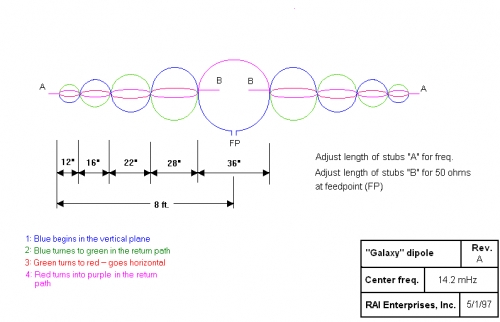
The “galaxy” dipole consists of approximately 50½ ft. of copper wire that is formed into a series of sinusoidal waves that become progressively smaller (or larger, depending upon the direction). A greater portion of the wire is twice folded back on itself in each half, with its waves occurring in both horizontal and vertical orientations to form a shape that is somewhat reminiscent of a series of spheres that have progressively smaller circumferences away from center. The end result is an electrically resonant dipole that is about ½ normal length that employs no lumped L or C or LC constants.

Construction details

A prototype was made of #12 solid copper wire using two joined 8′ lengths of 1½” PVC tubing as a support structure. Holes, in groups of four, are drilled through the PVC tubing (two vertical and two horizontal) at the specific points along its length where the wire waves will cross (and pass through). These holes are necessary in order to maintain wire position and wave-shape, and must be drilled slightly offset to prevent shorting between the crossing wires as they pass through.

The tubing sections are joined in the center with a 4-way sleeve in which short vertical sections of PVC tubing are inserted to support the top and bottom of the large center loop and feed-point. In retrospect, square fiberglass tubing would likely be a much better choice of material.

The numbers shown in the drawing below describes the length of each wave, and wire directions are color coded in an effort to illustrate the continuity. Short (3 to 6 inch) stubs are added at points A and B to allow some adjustment of the resonant frequency and feed-point impedance. This is accomplished by modifying the stub lengths as suggested. It is highly recommended that a 1:1 balun be employed at the feed-point (FP) to suppress common-mode feed-line radiation.

Performances

Although no calibrated field-strength comparisons were made, on-air transmit/receive tests suggested the VSWR bandwidth and overall performance was consistent with a full-sized dipole. It seemed he “Galaxy” dipole gave slightly better performance off the ends than was expected.

For other bands, simply scale the dimensions accordingly.


Article originally available at http://www.raibeam.com/galaxy/galaxy.html
Copyright by S. C. “Chuck” Smith WA7RAI
 

Leave a Reply

Your email address will not be published. Required fields are marked *

This site uses Akismet to reduce spam. Learn how your comment data is processed.

IW5EDI Simone

  • Licensed Amateur Radio operator in 1996 as IW5EDI, active member of ARI Firenze and ARRL
  • Class 1970, married with two childrens, love experimenting and antenna home-brewing. IT System Engineer, recently started having fun with morse code and Raspberry Pi


IW5EDI Simone


This Blog is mainly dedicated to Amateur Radio (Ham radio) and contains external articles and personal esperiences.

What is Amateur Radio ?
More Ham Radio Links


Blogroll

  • ARI Italian Amateur Radio Society 0
  • ARI Firenze ARI – Sezione di Firenze 0
  • ARRL Amateur Radio Relay League 0
  • DX Zone Ham Radio Internet Guide 0
  • DXSummit 0
  • DXWatch 0
  • eHam 0
  • Ham Radio Daily Ham Radio News 0
  • IW5EDI on QRZ.com My page on QRZ.com 0
  • Long Delayed Echoes 0

My Content

  • Antenna Projects 0
  • RadioAnnunci.it Mercatino Radioamatoriale 0

Categories

  • Articles (131)
    • Antenna Theory (13)
    • DXing (2)
    • How to (10)
    • shortwave (7)
  • Company and Products (1)
  • DXing (13)
    • QSLing (4)
  • Equipment (97)
    • Antenna (65)
    • Software Defined Radio (6)
  • Featured (28)
  • Ham Radio Events (25)
  • Ham Radio News (1)
  • Ham Radio Software (26)
  • HamRadio (94)
    • Ham Radio 2.0 (16)
    • How to (6)
    • Radio Scanning (6)
  • Homebrew (142)
    • HF Antennas (78)
    • Raspberry Pi (1)
    • UHF Antenna (16)
    • VHF Antennas (38)
  • Photos (4)
  • Short News (4)
  • Video (4)

Comments

  • Charles Mintoff on Ham Radio 2012
  • Roger Sparks, W7WKB on Petlowany Antennas by K6NO
  • Frank Barnes on Ameritron AL-80A restoration project
  • ken m3zkb on W5GI Mystery Antenna
  • Bobby on 5/8 Vertical Ground Plane antenna for 10 meters

RSS The DXZone.com

  • Top Amateur Radio Websites - Issue 2603
  • FT2: New Ultra-Fast Digital Mode Tested on HF
  • Top Amateur Radio Websites - Issue 2602
  • The G3LZR Tribander : The charm of the Impossible Antenna
  • Top Amateur Radio Websites - Issue 2601
  • Amateur Radio Clubs
  • AWARC Club Portable Repeater
  • 13cm Signal Generator for Amateur Radio
  • W6PQL 23cm Beacon Project
  • Budget Dummy Load for HAM Radio

Ham Radio Blog – IW5EDI Simone JN53OR

© 2026 IW5EDI Simone – Ham-Radio | Powered by Superbs Personal Blog theme