More than ten years ago a humorous article on antenna gain was published in the ham radio magazine “QRV.” The article stated that there are three kinds of gain:
1. the dB/d and dB/i gain based on CCIR regulations (the true and honest real gain!)
2. the “dB/ham radio gain,” which is 6dB higher than the real one.
3. the “dB/CB gain,” which is 10 dB higher than the real one.
Confused? Here is a little help so you can make your own calculations.
The gain of an antenna A compared to an antenna B is equal to the capture area of antenna A compared to the capture area of antenna B.
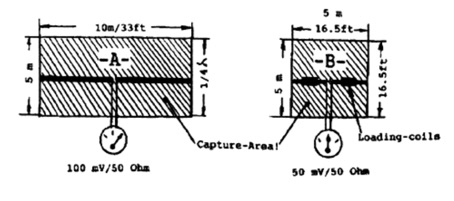
The capture area of an antenna is determined by multiplying the antenna’s radiator length by 1/4 lambda. See Figures 1 and 2.
Example:
Antenna A Full-size 20m antenna (made from CU-wire 2mm/1/16″ O.D. +/-)
14 MHz dipole 1/2 lambda long: = 10m x 5m (1/4 lambda) = 50 sq meters
The capture area of a 20m dipole is 50 sq. meters or 540 sq. ft. The gain of this antenna is zero dB/d or 2.14 dB/i.
Antenna B Shortened 20m antenna (CU-wire 2mm/1/16″ O.D. w/big loading coils)
radiator length 5m/16.5ft., tuned by two loading coils to 14.2 MHz = 5m x 5m = 25 sq. meter.
The capture area of antenna B is 25sq. meters or 270 sq. ft. Note: Antenna B has only half the capture area of antenna A and is therefore able to “catch” only 50 percent of the electromagnetic field; e.g., 50mV, compared to 100 mV/50 Ohms. This means 6dB less gain for antenna B in comparison to antenna A.
These calculations require extremely low loss coils. Since there is no such thing as “no-loss coils,” an additional loss of typically 3 to 8 dB has to be taken into account.
Imagine how much power is wasted while using such antennas for receiving/transmitting.
The fact is, that only 250 Watts of the 1,000 Watts HF in your feedline are radiated — and this with “extremely-low-loss loading coils.”
These kinds of calculations can be found in all good antenna books, usually presented in the form of rather intimidating mathematical formulas. We hope the explanation above prove helpful to you.
Some Typical Examples
A typical vertical antenna with 0 (zero) dB/D gain in space is the Sleeven 1/2-wave dipole. Other 0 dB/D gain systems are 1/2-wave antennas such as the Zepp-Windom-Fuchs and vertical radiators such as Ground Plane-Discone (all in space).
Antennas shorter than 1/2-wavelength (tuned by a loading coil or traps) have much less gain. Typical: 1/2-wavelength = 1/4 $#34;power gain” ±loss of traps/coils. Following are some examples:
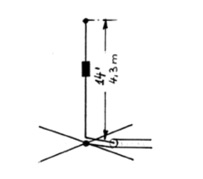
40 m GROUND PLANE 14 ft / 4.3 m high*, center loaded. Its efficiency is 7%. Its gain is -12 dB/D (compared to a full-size system without losses). This means that only 7 watts of a 100-watt signal will be radiated; 93 watts are wasted in this antenna.
See Ham Radio Magazine, Sept., 1982, P. 18 ff, by W1GV.
* A full-size 40 m 1/4 wavelength ground plane is 34.6 ft/10.5 m high; it has 0 dB/D gain.
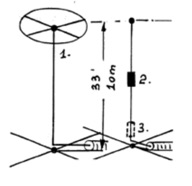
160 m GROUND PLANE 33 ft / 10 m high*, 12-Ohm ground
        Configuration                    Gain        Efficiency
1. Top loaded (big capacitor)           -10 dB          10.0%
2. Center loaded coil                   -19 dB           1.2%
3. Base loaded coil                     -20 dB           1.0%
All the gains are compared to a full size* radiator and 0-Ohm ground. At #2 and #3, only 1 watt of a 100-watt signal will be radiated; 99 watts are wasted.
See Ham Radio Magazine, May, 1983, p. 36 ff, by W7DHD.
* A full-size 160 m 1/4 wavelength ground plane is 136 ft / 41 m high.; it has 0 dB/D gain.
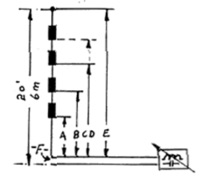
20 ft / 6 m long MULTIBAND ANTENNA 10-12-15-17-20 m Half-wave Zepp system. Open wire feedline or matchbox on “F”
Configuration      Gain         Efficiency
A=10 m          -0.5 dB/D          ~90%
B=12 m          -2 dB/D            ~63%
C=15 m          -4 dB/D            ~25%
D=17 m          -6 dB/D            ~15%
E=20 m          -8 dB/D            ~15%
Note: The traps were air coils, made from #9 copper wire, with air capacitors.
article originally available and copyright at sommerantennas.com website
Antenna gains are defined for transmission, not in terms of capture area. An ideal short dipole might have a lower capture area, and will have a lower radiation resistance, but its gain will not be reduced, except to the extent that you include resistive losses and the radiation resistance is too low compared with those. Even then the losses affect efficiency, not gain.
On HF receive, particularly for the lower bands, what matters is whether the sky noise captured dominates the receiver front end noise. As long as it does, even efficiency doesn’t matter on HF. The sky noise captured depends on effective sky temperature (which is high on lower frequencies), and capture area (which even for short dipole is much higher than on VHF.