Skip to content

IW5EDI Simone – Ham-Radio

Amateur Radio made in Italy

Menu
  • About me
    • QSL info
    • Log Book OnLine
    • What I Hear
    • Live Stream
    • Perchè (Why) in English ?
    • Contact me
    • Privacy info
  • Software
    • Ham Radio Deluxe 5.2
    • IP-Sound
    • OscillometerXZ
    • YO Yagi Optimizer
    • HamAlyzer 2.8
    • ERP Calculator
    • 59+ software
    • Magnetic Loop Calculator
    • MeterMate
    • UDY 2 Voice Keyer
  • Ham Radio
    • Beginners Guide to Ham Radio
    • Direct QSLing from Italy
    • Foreign Ham Operations in Italy
    • Tourist Ham Radio in Italy
    • Frequency List
    • Metric Conversion Table
    • Sound Card Interfacing for RTTY, PSK31, and SSTV
  • Technical Articles
    • Microphone Connections
    • A low cost 600 watt ultra-linear amplifier
    • VE7AVV – YAESU FL-2100Z Amplifier Repairs
    • Mic Wiring – Ham Radio
    • Homebrewing a balun
    • Grounding Concepts
    • HF Scanning frequencies
    • Wi-FI: Measuring network throughput
    • Determining RFI problems in mobile
    • Hidden and stealth antennas
  • Antennas
    • 144 / 430 Dual Band J-pole antenna
    • 10 Meter 4 Element Quad Antenna
    • 144 Mhz Magnetic Loop Antenna
    • A “loopy” Loop Loaded Vertical
    • W5GI Mystery Antenna
    • A Multiband Dipole
    • Build a W3DZZ Antenna
    • A portable 2-element VHF yagi
    • Assembling GAP Titan DX Antenna
    • The Galaxy Dipole
    • Pfeiffer Maltese Quad Antenna System
    • Magic Anti-Jamming antenna
    • D3+ High Performance Antennas
    • EH Antenna for 40 and 20 meters
    • Homebrew G5RV
    • 40 meter mini Moxon Antenna
    • EH Antenna for 10 meter
    • Quad and ModQuad Antenna
    • Inverted U antenna for 160 meters
    • 6 Band HF Windom antenna
    • The Bazooka Antenna
    • Antennas for HF mobile operation
    • Inverted L Antenna for Low Bands
    • Your first dipole
    • Remote control Antenna Switch
    • The gin pole
    • Hexbeam antenna setup
    • W4TI Rotor Installation
Menu

The Handi-Tenna 70 cm Portable Antenna

Posted on April 18, 2020April 18, 2020 by Simone

Here is a high-performance hand-held beam antenna that is easy to build and guaranteed to improve your downlink from the LEO satellites over ANY rubber duck or mobile whip. Like many satellite operators, I own an Arrow Antenna. That antenna is a great performer, but sometimes it is impractical for me to use it–it is just too big. I sometimes can use the dual-band mobile whip (mag mount) on my truck, but only on passes above 45 degrees (deaf below that).


What I really wanted was a small hand-held antenna I could fit under/behind the seat of my truck and just point out the window during a LEO pass. I recently conducted some experiments on a 4-element beam antenna for mode J downlink where I employed a folded-dipole feed to transform the feed impedance up from 25 Ohms to 100 Ohms–making circular polarization matching easy. I still had these parts laying around the garage (a.k.a. the R&D lab) and …

Design:
First, the design criteria:
1) It had to be flat enough to slide under my truck seat.
2) It had to be less than 18″ overall length.
3) It had to cost less than $2.00 to build.

This first criterion rules out any sort of circular polarity scheme. The second, allowing for a handle, limits the actual antenna length to about 12″. This last goal, of course, is up to the builder, but easily accomplished.

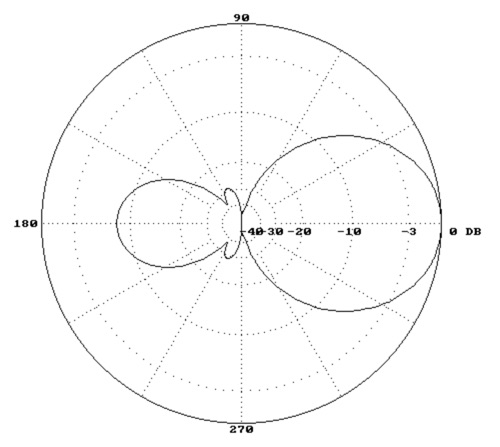
I designed this antenna as a very high-gain 3-element Yagi-Uda parasitic array. It has almost 10 dBi of free-space gain (9.7 dBi free-space and 15 dBi at 5′ elevation). This high gain is at the sacrifice of two key variables: front-to-back ratio and feedpoint impedance. The E-Plane azimuth plot at the right depicts the gain pattern. The minimal front-to-back ratio, about 8:1, should not pose a problem unless you are in an area of extremely high intermod interference. The nominal feedpoint impedance is a very low 12.5 Ohms for a conventional dipole feed. Instead, a folded-dipole feed element is used to transform the feedpoint impedance up to 50 Ohms (4:1 ratio). Of course, this antenna is linearly polarized.

Construction:

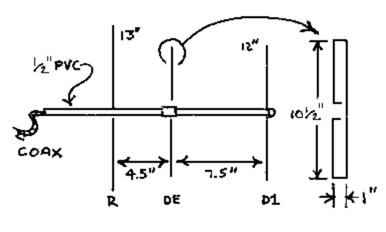
The basic antenna is built around a “boom” of 1/2″ PVC pipe cut to 18″ length. The antenna itself uses 12″ of the boom length and I left 5″ at the rear for the “handle” and 1″ at the front to attach a PVC cap–gives it that finished look.A PVC coupling is used at the feedpoint to connect a couple of # 6-32 x 1/2″ stainless steel bolts/nuts/washers to the coaxial cable (with crimpt style ring terminals). All three elements are formed from 10 gauge wire (insulated). The table below lists the dimensions and the sketch depicts the layout. These dimensions are fairly critical and you should strive for +/- 1/16″ accuracy. All copper wire is used and the coax (with ring lugs) connects directly to the driven element to minimize Ohmic losses.

El.      Length      Spacing
Ref     13.00 (33 cm)     0.00
DE     See Sketch     4.50 (11.5 cm)
D1     12.00 (30.5 cm)     12.00 (30.5 cm)


Install the driven element (make sightly larger and trim for SWR) and the director, but just try taping the reflector to the boom first. After adjusting the driven element for best SWR at 436.8 mHz, you can move the reflector slightly to get the SWR perfect. I used glue to hold the reflector and director in place and then spray painted the whole assembly a traditional aluminum color for a nice finished look. After all, if you are going to wave this thing around in the air and point it up in the sky, you want it to look profesional for the dumbfounded onlookers 🙂

I used RG-8X and not the more common RG-58. For an equivalent 10′ (2.5 m) of coax, RG-58 has 1.2 dB loss while RG-8X has only 0.8 dB loss. With LEO satellites, every fraction of a dB counts.


Performance:
As the bird (AO-27) comes over the horizon, I hear the tell-tale signs of FM quieting. By 5 degrees above the horizon I can make out about 50 percent of the in-and-out audio. By 10 degrees above the horizon, the signal is strong and by 15 degrees it is full quieting. In terms of comparison, I get full-quieting at about 5 degrees with my Arrow Antenna.

I can also confirm (again) the polarization of choice for AO-27 is vertical. At times, a slight tilt of the antenna improves reception, but placing it horizontal completely obscures the signal.

This antenna makes a nice companion to the 2 meter vertical and can be used mobile, like I use it, or as a fairly light and compact backpacking setup.

Article by K5OE originally available at members.aol.com/k5oejerry/handi-tenna.htm

Leave a Reply

Your email address will not be published. Required fields are marked *

This site uses Akismet to reduce spam. Learn how your comment data is processed.

IW5EDI Simone

  • Licensed Amateur Radio operator in 1996 as IW5EDI, active member of ARI Firenze and ARRL
  • Class 1970, married with two childrens, love experimenting and antenna home-brewing. IT System Engineer, recently started having fun with morse code and Raspberry Pi


IW5EDI Simone


This Blog is mainly dedicated to Amateur Radio (Ham radio) and contains external articles and personal esperiences.

What is Amateur Radio ?
More Ham Radio Links


Blogroll

  • ARI Italian Amateur Radio Society 0
  • ARI Firenze ARI – Sezione di Firenze 0
  • ARRL Amateur Radio Relay League 0
  • DX Zone Ham Radio Internet Guide 0
  • DXSummit 0
  • DXWatch 0
  • eHam 0
  • Ham Radio Daily Ham Radio News 0
  • IW5EDI on QRZ.com My page on QRZ.com 0
  • Long Delayed Echoes 0

My Content

  • Antenna Projects 0
  • RadioAnnunci.it Mercatino Radioamatoriale 0

Categories

  • Articles (131)
    • Antenna Theory (13)
    • DXing (2)
    • How to (10)
    • shortwave (7)
  • Company and Products (1)
  • DXing (13)
    • QSLing (4)
  • Equipment (97)
    • Antenna (65)
    • Software Defined Radio (6)
  • Featured (28)
  • Ham Radio Events (25)
  • Ham Radio News (1)
  • Ham Radio Software (26)
  • HamRadio (94)
    • Ham Radio 2.0 (16)
    • How to (6)
    • Radio Scanning (6)
  • Homebrew (142)
    • HF Antennas (78)
    • Raspberry Pi (1)
    • UHF Antenna (16)
    • VHF Antennas (38)
  • Photos (4)
  • Short News (4)
  • Video (4)

Comments

  • Charles Mintoff on Ham Radio 2012
  • Roger Sparks, W7WKB on Petlowany Antennas by K6NO
  • Frank Barnes on Ameritron AL-80A restoration project
  • ken m3zkb on W5GI Mystery Antenna
  • Bobby on 5/8 Vertical Ground Plane antenna for 10 meters

RSS The DXZone.com

  • Top Amateur Radio Websites - Issue 2603
  • FT2: New Ultra-Fast Digital Mode Tested on HF
  • Top Amateur Radio Websites - Issue 2602
  • The G3LZR Tribander : The charm of the Impossible Antenna
  • Top Amateur Radio Websites - Issue 2601
  • Amateur Radio Clubs
  • Shrunken Quad
  • DIY Magnetic Loop Antenna Tutorial with Remote Tuning System
  • HF Beacon Tracker: Real-Time 3D Propagation Visualization
  • WSJT-X FT2 fork Decodium

Ham Radio Blog – IW5EDI Simone JN53OR

© 2026 IW5EDI Simone – Ham-Radio | Powered by Superbs Personal Blog theme