Editors notes: The antennas described in this article were built as the result of several discussions between Kent and a Cuban radio operator. While there are plenty of high performance antenna designs, most of the parts required to build them are not available in Cuba. There just isn’t an EPO or Radio Shack available in Cuba. Kent accepted this as a challenge to design a really good antenna that could be built with little more than ground wire, coax and a wooden boom. Using the latest antenna design software, he has developed several variations for 144 thru 1296 MHz. Apparently, the designs work very well… Kent entered the 432 MHz version in a recent antenna contest and lost by 0.2 dB to a Midwest ham who had copied his design. Though disappointed in losing, it did prove to Kent that the antennas can be easily replicated with consistant performance.]
If you’re planning to build an EME array, don’t use these antennas. But, if you want to put together a Rover station with less than $500 in the antennas or just want a good antenna for the home, read on.
These antennas are relatively small, easily constructed from common materials/tools and have surprising performance. The feed method is greatly simpified by directly soldering the coax to the driven element. No baluns or gamma matches are used in this design. This simplified feed uses the structure of the antenna itself for impedance matching. The spacing of the director and reflector elements from the driven element directly affects the feed point impedance of the antenna. So, the design starts with the feed (driven element) and the elements are built around it. Typically, a high gain antenna is designed in the computer, then you try to come up with a matching arrangement for a 31.9 Ohm feed! For the cost about 0.5 dB of gain, these antennas make some design compromises for the feed impedance, use an asymmetrical feed and make trade offs for a very clean pattern. But, they allow simple measurements, have wide bandwidth, the ability to grow with the same element spacing AND… you can build these antennas for $5!!!!
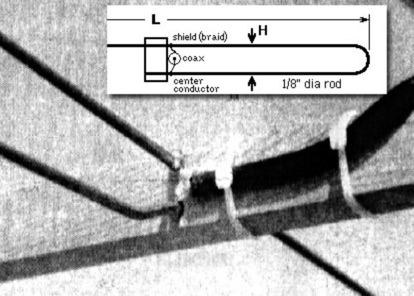
The booms used for these antennas is 1/2″ X 3/4″ wood. The elements have been made from silicon bronze welding rod, aluminum rod, hobby tubing and solid ground wire with no change in performance. Since you want to be able to solder to the driven element, silicon bronze welding rod, hobby tubing and #10 or #12 solid copper wire have been used and work fine. A drop of “Super Glue”, epoxy or RTV is used to hold the elements in place. A good coat of Polyurethane should be applied to the wooden boom to protect it from the weather. A polyurethane varnished 902 MHz version has been in the air for a year now with little deterioration in performance.
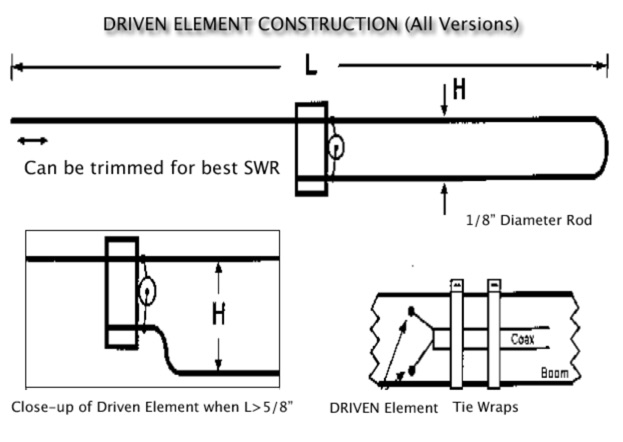
And now for the antenna designs. These antennas have been carefully designed to have the highest dB’s/Dollar ratio of anything around They were designed with YagiMax, tweaked using NEC and the driven elements experimentally determined on the antenna range. The driven element design is the same for all frequencies except for the length (L) and separation (H). See the drawing below for details on the driven element. All dimensions are in inches.

Antenna Designs By Band:
144 MHz. This antenna is peaked for 144.2 MHz but performance is still good at 146.52 (emergency use only!). Driven element dimensions are L = 38.5″ and H = 1.0″ Elements are 1/8″ diameter.
| 144 MHz | REF | DE | D1 | D2 | D3 | D4 | |
| 3 Ele | Length Spac’g | 41.00 0.00 | 8.50 | 37.00 20.00 | |||
| 4 Ele | Length Spac’g | 42.00 0.00 | 8.50 | 37.50 19.25 | 33.00 40.50 | ||
| 6 Ele | Length Spac’g | 40.50 0.00 | 7.50 | 37.50 16.50 | 36.50 34.00 | 36.50 52.00 | 32.75 70.00 |
222 MHz. This antenna is peaked for 222.1 MHz but performance barely changes at 223.5 MHz. Driven element dimensions are L = 24.5″ and H = 1.0″ Elements are 3/16″ diameter.
| 222 MHz | REF | DE | D1 | D2 | D3 | D4 | |
| 3 Ele | Length Spac’g | 26.00 0.00 | 5.50 | 23.75 13.50 | |||
| 4 Ele | Length Spac’g | 26.25 0.00 | 5.00 | 24.10 11.75 | 22.00 23.50 | ||
| 6 Ele | Length Spac’g | 26.25 0.00 | 5.00 | 24.10 10.75 | 23.50 22.00 | 23.50 33.75 | 21.00 45.50 |
432 MHz. This antenna is peaked for 432.1 MHz. At this frequency, this antenna is getting very practical and easy to build. Driven element dimensions are L = 13.0″ and H = 3/8″ Elements are 1/8″ diameter.
| 432MHz | REF | DE | D1 | D2 | D3 | D4 | D5 | D6 | D7 | D8 | D9 | |
| 6 Ele | Length Spac’g | 13.50 0.00 | 2.50 | 12.50 5.50 | 12.00 11.25 | 12.00 17.50 | 11.00 24.00 | |||||
| 8 Ele | Length Spac’g | 13.50 0.00 | 2.50 | 12.50 5.50 | 12.00 11.25 | 12.00 17.50 | 12.00 24.00 | 12.00 30.75 | 11.25 38.00 | |||
| 11 Ele | Length Spac’g | 13.50 0.00 | 2.50 | 12.50 5.50 | 12.00 11.25 | 12.00 17.50 | 12.00 24.00 | 12.00 30.75 | 12.00 38.00 | 11.75 45.50 | 11.75 53.00 | 11.00 59.50 |
902/903 MHz. This was the first antenna I built using the antenna to control the driven element impedance. The 2 1/2′ length has proven practical, so I haven’t built any other versions. Driven element dimensions are L = 5.7″ and H = 1/2″ Elements are 1/8″ diameter.
| 902/3 MHz | REF | DE | D1 | D2 | D3 | D4 | D5 | D6 | D7 | D8 | |
| 10 Ele | Length Spac’g | 6.20 0.00 | 2.40 | 5.60 3.90 | 5.50 5.80 | 5.50 9.00 | 5.40 12.40 | 5.30 17.40 | 5.20 22.40 | 5.10 27.60 | 5.10 33.00 |
1296 MHz. This antenna is the veteran of several “Grid Peditions” but I have yet to actually measure the gain. Dimensions must be followed with great care. The driven element is small enough to allow 0.141 semi-rigid coax to be used instead of RG-58. Silicon Bronze welding rod was used for the elements but any material can be used. Driven element dimensions are L = 4.0″ and H = 1/2″ Elements are 1/8″ diameter.
| 1296 MHz | REF | DE | D1 | D2 | D3 | D4 | D5 | D6 | D7 | D8 | |
| 10 Ele | Length Spac’g | 4.30 0.00 | 1.70 | 3.90 2.80 | 3.80 4.00 | 3.75 6.40 | 3.75 8.70 | 3.65 12.20 | 3.60 15.60 | 3.60 19.30 | 3.50 23.00 |
OTHER VERSIONS
421.25 MHz ATV. 421 MHz Vestigial Sideband video is popular in North Texas for receiving the FM video repeaters. The driven element for these antennas is designed for an impedance of 75 ohms. So RG-59, or an `F’ adapter to RG-6, can be directly connected to a cable TV converter/Cable Ready TV on channel 57. Driven element dimensions are L = 13.0″ and H = 1/2″ Elements are 1/8″ diameter. Spacing is the same for all versions.
| 421 MHz ATV | REF | DE | D1 | D2 | D3 | D4 | D5 | D6 | D7 | D8 | D9 | |
| 6 Ele | Length | 14.00 | 12.50 | 12.25 | 12.25 | 11.00 | ||||||
| 8 Ele | Length | 14.00 | 12.50 | 12.25 | 12.25 | 12.00 | 12.00 | 11.25 | ||||
| 11 Ele | Length Spac’g | 14.00 0.00 | 3.00 | 12.50 6.50 | 12.25 12.25 | 12.25 17.75 | 12.00 24.50 | 12.00 30.50 | 12.00 36.00 | 11.75 43.00 | 11.75 50.25 | 11.50 57.25 |
450 MHz FM. Yea, I understand it’s FM, but sometimes a newcomber needs a cheap antenna to get into a repeater or give you a simplex QSO during a contest. Driven element dimensions are L = 12.0″ and H = 3/8″ Elements are 1/8″ diameter. Spacing is the same for all versions.
| 450 MHz FM | REF | DE | D1 | D2 | D3 | D4 | |
| 6 Ele | Length Spac’g | 13.00 0.00 | 2.50 | 12.10 5.50 | 11.75 11.00 | 11.75 18.00 | 10.75 28.50 |
435 MHz AMSAT. The larger versions have not been fully tested and I appreciate the help and motivation from KA9LNV for these antennas. Updates and performance evaluations are planned for a later edition of the AMSAT Journal. A high Front-to-Back ratio was the major design consideration for all versions. The computer predicts 30 dB F/B for the 6 element and over 40 dB for the others. NEC predicts 11.2, 12.6, 13.5 and 13.8 dBi for the 6, 8, 10 and 11 element respectively. Using 3/4″ square wood makes it easy to build two antennas on the same boom for cross- polarized operation. Offset the two antennas 6 1/2″ and feed in phase for Circular Polarization. Or, just build one antenna for portable operation. Driven element dimensions are L = 13.0″ and H = 1/2″ Elements are 1/8″ diameter. Spacing is the same for all versions.
| 435 MHz AMSAT | REF | DE | D1 | D2 | D3 | D4 | D5 | D6 | D7 | D8 | D9 | |
| 6 Ele | Length | 13.40 | 12.40 | 12.00 | 12.00 | 11.00 | ||||||
| 8 Ele | Length | 13.40 | 12.40 | 12.00 | 12.00 | 12.00 | 12.00 | 11.10 | ||||
| 10 Ele | Length | 13.40 | 12.40 | 12.00 | 12.00 | 12.00 | 12.00 | 11.75 | 11.75 | 11.10 | ||
| 11 Ele | Length Spac’g | 13.40 0.00 | 2.50 | 12.40 5.50 | 12.00 11.25 | 12.00 17.50 | 12.00 24.00 | 12.00 30.50 | 11.75 37.75 | 11.75 45.00 | 11.75 52.00 | 11.10 59.50 |
by Kent Britain, WA5VJB (edited by John Maca, AB5SS)
What about 6 meter vervsion.