How can you vastly improve your Medium Wave reception? its quite simple really, all you need is 120 foot of wire, a few lengths of timber and an old tuning capacitor with which you can build the answer to every DX’ers prayers, a tuned loop antenna.
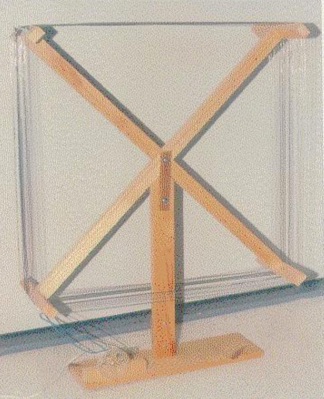
This simple Do-It-Yourself project, which will probably cost you no more than £10, will enable you to improve the clarity of reception on medium-wave radio stations to an unbelievable level.
NOTE: This graphic of the tuned loop antenna is slightly different from the one described here in the building instructions, in that it has a central leg on which to stand, this is only a cosmetic feature and is not necessary to the better reception of a radio signal.
The results of these amazing antennas really and truly has to be heard to be believed. So how do I build one? I hear you ask impatiently. I’ll keep you in suspense for a few minutes, firstly I’ll explain a little of the background of the tuned loop antenna.
What is a Tuned Loop Antenna?
The loop antenna is designed primarily for the AM band, which utilises the 530 khz to 1620 khz section of the radio spectrum.
Indeed there are two different types of loop antennas, The first of these is the ferrite bar as build into practically every portable radio, the other is wound on an air-core form, and is far less popular with radio manufacturers because of its size, this is known as a tuned loop antenna.
A loop antenna is very directional. The pickup pattern is shaped like a figure eight. The loop will allow signals on opposite sides to be received, while off the sides of the loop the signal will decrease or be nulled out. The nulling feature will allow you to remove a local station on a frequency and pick up another on the same frequency by removing the local signal.
For example, I could be listening to Magic 1548 from Liverpool on 1548 khz from my home in Ireland, also on that same frequency I can faintly pick up some music and chat from another radio station on the same frequency, so I turn the loop antenna around slightly in the general direction of this other radio station and as if by magic, I can now hear a very clear signal from this other station which turns out to be BBC Radio Bristol, at the same time the signal from Magic 1548 has faded somewhat into the background mush.
Air core loop antennas come in many sizes. The larger the loop the more gain there is. A smaller loop will actually lose part of the signal. There are two ways a loop can be wound, box or spiral. In the box or solenoid loop the plane of the windings are wound perpendicular to the diameter of the loop, so each loop is the same size. In the spiral loop the plane of the windings are wound parallel with the diameter of the loop, so each loop gets smaller as you wind into the centre of the loop. A loop needs to be able to rotate to null out a station. And a loop also needs to be able to tilt from vertical. This also helps in in nulling of a signal (alt-azimuth feature).
The number of turns the loop needs is determined by the size of the loop, the frequency range that you want to tune and the value of your tuning capacitor. The larger the loop the fewer turns you will need. A 4 foot loop needs 8 turns and a 2 foot loop needs 18 turns. The capacitor that is used is the standard AM tuning capacitor with a range of 10 to 365 pf. The tuning capacitor is used to tune the loop to the frequency that you want to listen to. When you are tuned in to the frequency the signal will peak. You may not be able to tune the full frequency range that you want to tune. So you will need to use a 2 section capacitor and switch the second section in. (more capacitance)
There are three ways that you can connect your loop to your radio.
One way is not connecting it at all, this requires a portable radio with a internal loop antenna in the form of a ferrite rod. The field of the loop will radiate the peaked signal and you will be able to pick it up with no connection to the radio. You can move the radio around to get the best reception.
The second way is to get a direct coupling to the loop which is used as a pick-up coil, This consists of one turn of wire wound around the circumference of the loop, this is then connected to the radio’s antenna socket by means of a removable flying lead.

I am 80 and have been around radio, etc. for at least 70 of those years but I have never heard of a “removable flying lead” so I would like a simple explanation. I cannot find it in a Google search… It is probably really simpile as I have a habit of making things too complex.
Hi Simone,
You say, “There are three ways that you can connect your loop to your radio” but then I see two descriptions…I am curious, how does the third way work?
I am asking because I need to recreate an antenna — for a LW receiver — that is lost. In the schematic, it appears the loop (terminated with a variable capacitor) is tapped at two points, about midway of the wire and connected directly to receiver. Would that work?
All the best and many thanks,