Article by W2BRI
After many requests by Ben W4KSY*, someone I consider to be my loop mentor, I decided to post a page about my 80 meter magnetic loop. The idea for this loop began with my purchase of a new vertical antenna. Now when you think of 26 feet of antenna, it doesn’t seem that large until you put it together. Now add a couple of 1/4 wavelength 80 meter radials, and the vertical antenna solution starts to get big. Now, I’m into efficiency, and I wanted to string four radials five feet above ground at 90 degrees, and set the whole system up in the best possible way. However, when I moved into my new house, I had the disturbing reality that I had many power lines running across my property and I also didn’t have close to the room for 1/4 wavelength or even 1/8 wavelength radials (even for 40 meters). So I figured I’d never get on the low bands and I’d have to live with 20 meters forever. Don’t get me wrong, I love 20 Meters.
It’s no secret, I am a big fan of Force-12 antennas. I own a Force-12 C3SS triband beam, and can’t complain a bit about it. I call CQ on that antenna, and I get five people coming back to me almost every time. While I was at the ARRL conference last year I met Tom, N6BT one of the owners of Force-12, and picked up his book “Array of Light.” The book chronicles his experiences designing, building, and putting up thousands of antennas (yes, thousands!). It is a great book in my opinion, and a must read for those interested in understanding the ‘reality’ of antennas. As I went through the book I found a chapter on magnetic loop antennas and their high efficiency. The wheels in my head started turning, and I thought, I could manage putting up an 80 meter loop in my backyard. Maybe 80 meters isn’t out of my grasp.
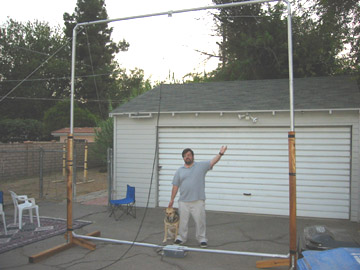
So I picked up the phone and called Tom at Force-12 and asked him what he thought. He told me sure, he’d be happy to build a loop for me but the capacitor arrangement and the loop support would be my problem. I agreed and after several emails back and forth and a couple of months (and dollars), I received a very large box on the door steps of my house. The box was filled with 2 inch 4 foot lengths of aluminum. Each piece was tapered at the end so it would fit into another piece with about 3 inches of overlap. Then a bolt was inserted between the connected pieces, and each section was completed. the corners had a similar tapering, and it took a whole 15 minutes to put it together by the garage.
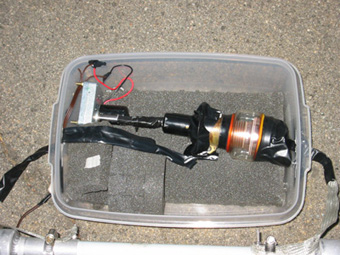 At first I used coaxial stubs for a capacitor. Tom suggested this strategy. You can cut coax and use it as a capacitor — take several different lengths of coaxial stubs equaling different amounts of capacitance, and move from band to band. I even loaded the loop onto 160 meters, but that’s another story for later. I built two wooden supports for the loop with my friend Steve, and we attached the loop into place. I was ready for 80 meter action.
Great, I had the loop built, but getting it to match and work was a whole different story. I had read many articles by Ben W4KSY about loops, so I thought since I was having some problems I’d ask him via email what to do. Well he was kind enough to instruct me about how the feed system works (the one from Tom was too small), and how to re-work it and what to expect. We emailed a bunch of times and I finally got it where I wanted it, 3.863 at 1.1 VSWR with about 10 KHZ in either side of bandwith (remember, with loops you don’t want a whole lot of bandwith — but this was an acceptable range).
With excitment that first night I turned on the rig to 3.863, and heard a bunch of guys in the bay area (from my QTH in Los Angeles). I popped my call in with 100 watts, and they came back first time around. I heard everyone in the round table, and everyone heard me. Night after night, QSO after QSO, 99% of the time, everyone hears me and I hear them. No problem. And this was during summer conditions. I worked many stations regularly from Oregon to mobiles in Wyoming, stations in Arizona, and others up and down the coast. Now when the propagation changes in early fall I am working stations farther out, Texas, Colorado, and Oklahoma. I am looking forward to winter conditions to give more reports.
I eventually upgraded the capacitor to a Jennings vacuum variable 5-750 pf with a over 12KV rating (cost around 200 bucks), and fixed on a motor to drive the capacitor up and down the bands. The motor controller is in the shack and I use a pair of DPDT relays connected to momentary pushbuttons to pulse the motor onto frequency. It works like a champ.
So, can you work 80 meters with a 12×12 loop 6 inches off the ground, yes! And you’ll have a blast doing it.
For more technical explanations I plan on adding more info relating to large loops on the site, and will be happy to email.
73,
Brian, W2BRI
this article was previously available at http://www.standpipe.com/w2bri/80meter.htm
Hi
My name is George G4GRR. I am trying to download Cobracom – Waveguide from your site and the link it gives but without success. Will you send me a direct download link?
Best wishes
73’s
George