The following diagrams and tables show some simple 1:1 and 4:1 baluns for use between 1.8 and 30 MHz using twin transmission lines made from enamelled copper wire (ecw). The bifilar windings have been adjusted (spacing) to produce transmission lines with Zo of 50 or 75 ohms as required for best matching. These designs should be suitable for 100-200 Watt operation.
RF transformers should always operate within safe limits of temperature and linearity. The following designs which use toroid cores can be checked for safe operating conditions with the programs included in Programs.
Materials required:
- Ferrite Core: Select either rod or toroid core as detailed below
- Core insulation: 1 layer of ptfe tape (plumbers thread sealing tape); plumbing and hardware suppliers
- Wire: 1.0 or 1.25mm enamelled copper wire (ecw) as specified; electronics shops
- Spacing material: Kinnears 540 TEX colourfil twine; product code K 069048; newsagents, craft suppliers
- Note: This spacing material is polypropylene; other material is probably suitable, but ensure it will not absorb moisture.
Winding Methods
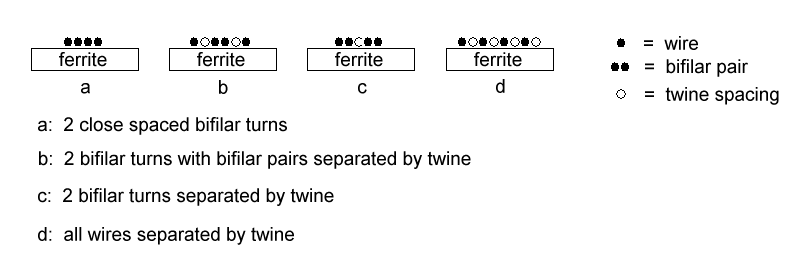
Examples of winding methods a, b, c, d on a rod.
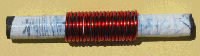
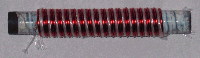
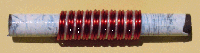
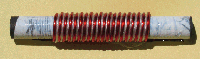
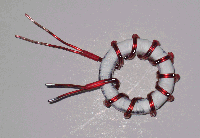
1:1 Rod Balun
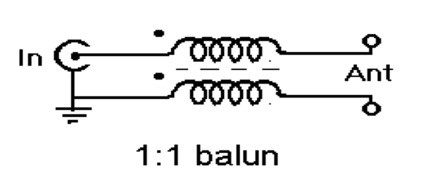 Ferrite Rod: R-61-037-300
Construction:
Start by winding a layer of ptfe tape on the rod
Cut two 750mm lengths of 1.25mm ecw for a bifilar winding.
Starting at the centre of the rod, close wind half the length of the wires towards one end. Repeat for the other half. 15 bifilar turns (2 wires) should now be centred on the rod, with sufficient end lengths for terminations.
Cut the spacing twine into 750mm lengths and insert between the wires as required by tightly pulling the cord between the turns. This makes a secure finished winding. Start at the centre of the winding and work towards each end.
For a 50 ohm balun put spacing twine between the bifilar turns (winding method c).
For a 75 ohm balun put spacing twine between all wires (winding method d).
Waterproof, terminate and house the finished balun as required.
Test Results for 50 and 75 ohm 1:1 Rod Balun Using R-61-037-300
Measurements taken on Autek VA-1 analyzer – with normal inaccuracies – showing swr.
Windings for 50:50 ohm: 15 turns 1.25mm winding wire bifilar wound, with twine between bifilar turns.
Windings for 75:75 ohm: 15 turns 1.25mm winding wire bifilar wound with twine between all turns.
Spacing material: Kinnears 540 TEX colourfil twine; product code K 069048; newsagents, craft suppliers.
| Freq (MHz) | SWR | |
|---|---|---|
| 50:50 | 75:75 | |
| 1.8 | 1.06 | 1.05 |
| 3.55 | 1.06 | 1.04 |
| 5.0 | 1.06 | 1.04 |
| 7.05 | 1.06 | 1.02 |
| 10.1 | 1.06 | 1.01 |
| 14.2 | 1.04 | 1.01 |
| 18.1 | 1.06 | 1.04 |
| 21.2 | 1.04 | 1.04 |
| 28.5 | 1.11 | 1.18 |
4:1 Rod Balun
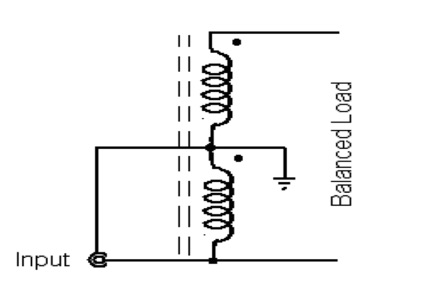
Ferrite Rod: R-61-037-300
Use the same winding method and materials as in the rod balun above.
Construction:
Cut two 750mm lengths of 1.0mm ecw for a bifilar winding.
Wind 15 bifilar turns centred and close spaced on the rod.
Wind spacing twine between all turns as described above (winding method d).
Test Results for 50 and 75 ohm 4:1 Rod Balun Using R-61-037-300
Measurements taken on Autek VA-1 analyzer – with normal inaccuracies – showing swr.
Windings for 50:200 and 75:300 ohm: 15 turns 1.0mm winding wire bifilar wound, with twine between all turns.
Spacing material: Kinnears 540 TEX colourfil twine; product code K 069048; newsagents, craft suppliers.
| Freq (MHz) | SWR | |
|---|---|---|
| 50:200 | 75:300 | |
| 1.8 | 1.39 | 1.64 |
| 3.55 | 1.17 | 1.32 |
| 5.0 | 1.12 | 1.14 |
| 7.05 | 1.03 | 1.04 |
| 10.1 | 1.03 | 1.02 |
| 14.2 | 1.00 | 1.08 |
| 18.1 | 1.03 | 1.06 |
| 21.2 | 1.02 | 1.15 |
| 28.5 | 1.10 | 1.31 |
1:1 Toroid Balun
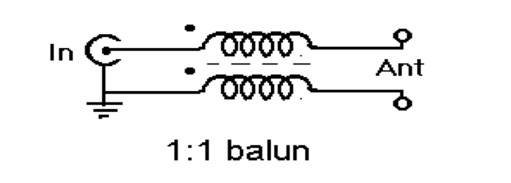 Ferrite Toroid: FT-140-61.
Use the same winding method and materials as in the rod balun above.
Construction:
Spread the 12 bifilar turns of 1.25mm ecw evenly around the core. This leaves space between the 12 turns.
If the lowest operating frequency is 3.5MHz then 10 turns is sufficient.
For a 50 ohm balun the bifilar pairs are close spaced (winding method a).
For a 75 ohm balun put spacing twine between the bifilar pair(winding method b).
Test Results for 50 and 75 ohm 1:1 Toroid Balun Using FT-140-61
Measurements taken on Autek VA-1 analyzer – with normal inaccuracies – showing swr.
Windings for 50 ohm: 12 turns 1.25mm winding wire bifilar wound, all close spaced .
Windings for 75 ohm: 12 turns 1.25mm winding wire bifilar wound with twine between bifilar pair.
Spacing material: Kinnears 540 TEX colourfil twine; product code K 069048; newsagents, craft suppliers.
| Freq (MHz) | SWR | |
|---|---|---|
| 50:50 | 75:75 | |
| 1.8 | 1.06 | 1.06 |
| 3.55 | 1.04 | 1.04 |
| 5.0 | 1.10 | 1.06 |
| 7.05 | 1.09 | 1.04 |
| 10.1 | 1.12 | 1.05 |
| 14.2 | 1.23 | 1.07 |
| 18.1 | 1.16 | 1.11 |
| 21.2 | 1.26 | 1.13 |
| 28.5 | 1.37 | 1.26 |
4:1 Toroid Balun
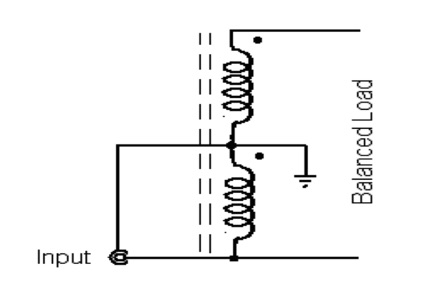 Ferrite Toroid: FT-140-61.
Use the same winding method and materials as in the rod balun above.
Construction:
Spread the 12 bifilar turns of 1.25mm ecw evenly around the core. This leaves space between the 12 turns.
If the lowest operating frequency is 3.5MHz then 10 turns is sufficient.
For the 50:200 ohm balun the bifilar pairs are close spaced (winding method a).
For the 75:300 ohm balun put spacing twine between the bifilar pair (winding method b).
Test Results for 50:200 and 75:300 ohm 4:1 Toroid Balun Using FT-140-61
Measurements taken on Autek VA-1 analyzer – with normal inaccuracies – showing swr.
Windings for 50:200 ohm: 12 turns 1.25mm winding wire bifilar wound, all close spaced turns.
Windings for 75:300 ohm: 12 turns 1.25mm winding wire bifilar wound with twine between bifilar pair.
Spacing material: Kinnears 540 TEX colourfil twine; product code K 069048; newsagents, craft suppliers.
| Freq (MHz) | SWR | |
|---|---|---|
| 50:200 | 75:300 | |
| 1.8 | 1.18 | 1.34 |
| 3.55 | 1.12 | 1.17 |
| 5.0 | 1.06 | 1.10 |
| 7.05 | 1.03 | 1.06 |
| 10.1 | 1.04 | 1.02 |
| 14.2 | 1.04 | 1.05 |
| 18.1 | 1.13 | 1.08 |
| 21.2 | 1.13 | 1.07 |
| 28.5 | 1.13 | 1.20 |
Article byÂ
RJ & US IMPORTS
originally available at users.catchnet.com.au/~rjandusimports/index.html