An Inverter U for the top band
Do you find it hard to get on top band because of the antenna? This is a simple wire antenna that may be just what you need.
It installs easily, needs no elaborate ground system, yet performs very well. A small ingenuity solves two connundrums at once – getting the current high in the air, and lowering the current in a very simple ground system.
Common problems – antenna too large
One way to meet the size problem is by wrapping a loop antenna around the house, tuned to resonance with a capacitor.
With today’s electromagnetic safety concerns this may not be the best way to meet RF exposure limits.
Another simple approach is a vertical whip with center and/or bottom loading coils. But a resonant 160 meter vertical is more than 120 feet high.
Shorter whips need to be tuned to resonance with coils, and these are lossy.
The best coil may have a Q of 330 or so, and many home-brew coils have Q’s much lower than that. It’s not uncommon to need 1000 ohms of inductance from a coil of Q=200, which puts 5 ohms of resistance in series with the antenna.
The antenna’s radiation resistance may well be below 5 ohms, and usually is. Therefore, most of the power goes into heating the coil and the ground system. To get the maximum radiated power, antenna current must be as high, both in amperes and elevation above ground, as possible.
Loaded vertical antennas have a current maximum at the ground. Therefore the ground system must ‘sink’ this current. Every ohm of ground resistance is critical, as the I-squared R loss in the ground is lost power. In standard (AM) broadcast antennas, low ground resistance is accomplished by using a minimum of 120 radials spaced at 3 degree intervals. For amateur work, this is again a formidable undertaking.
A bit of ingenuity
If a 160 meter whip were made more than 135 feet high, the point of maximum current would no longer be at the ground; its feed impedance would be greater than the quarter-wave 38 ohm value, and would be inductive, not capacitive. A series capacitor would be needed to bring it to resonance. Now, capacitors have higher Q’s than coils – they can easily be more than 1000. Since a -taller than quarter wave- vertical will both exhibit a higher radiation resistance (and, hence, a lower feedpoint current), and can be tuned with a high-Q capacitor, the power lost in the tuning element will be a smaller fraction of the total power than with base-loaded shorter verticals. The current throught the capacitor will be lower than that through a loading coil, and its I-squared R loss will be less than the loss through a tuning coil. The need to ‘sink’ a lower current in the ground system allows a simplified design to be used effectively. This, and the other effects just discussed, lead to a really easy-to-construct vertical for 160 meters.
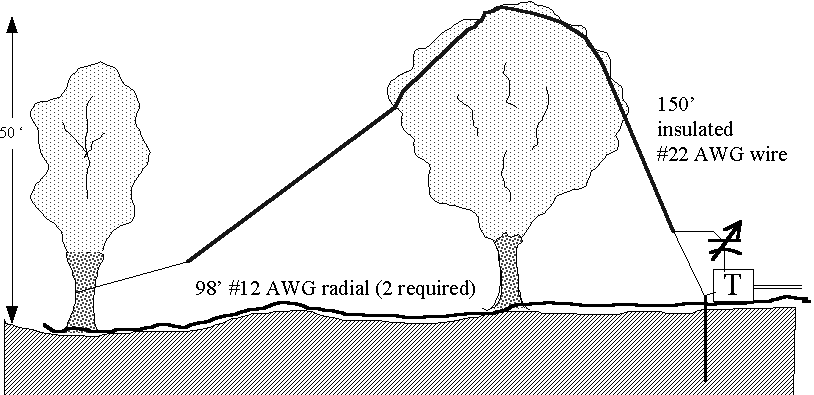
Some experimentation on the ideas above led me to take 150 feet of insulated #22 hookup wire and draw it through the crown of a cooperating oak tree: the tree is about 60 feet high. I used my fishing rod, monofilament line, a one-ounce lead ‘egg’ sinker, and a ‘wrist-rocket’ slingshot to put the line over the crown of the tree. By untying the lead weight at the far end (at ground level) and attaching nylon ‘chalk line,’ I was able to pull the chalk line over the tree back to the starting point.
Next I tied one end of the hookup wire to the chalk line, and fastened the other end to a stake driven into the ground. I then pulled the wire over the tree’s crown and down the other side. By pulling the chalk line away from the tree and the stake, I was able to bring the wire very lightly taut and fasten the line to another tree. The free end of the wire was kept at least 10 feet off the ground at this time for safety, and to avoid excessive detuning.
A ground rod 8′ long and 5/8″ in diameter – the type used for electric service entrance grounding and available at many hardware stores, electrical supply houses, and some radio shack stores – was driven into the ground at the feed point. The feed end of the wire was tied to this stake with about 1 foot of chalk line.
The Ground System
At the same time, its feed impedance rises from 76 ohms to about 200 ohms. Therefore, I placed a 198 foot piee of insulated #12 wire on the ground as if it were a center fed dipole, with its center at, and bonded to, the ground stake mentioned above. This arrangement yields a ground system whose impedance is on the order of 60 ohms. Since the antenna feed impedance is on the order of 150 ohms, the ground loss is only about 1/3 of the total supplied power – quite a bit less than with a short vertical.
Feeding the Antenna
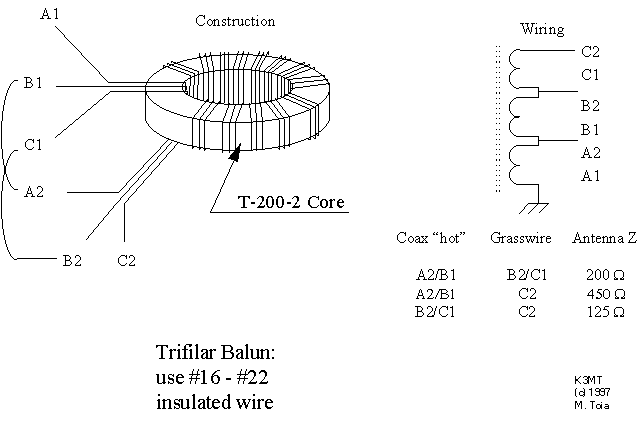
The antenna’s feed impedance is on the order of 200 ohms. To feed it, I use a trifilar balun as shown here, taken from my article on the grasswire antenna. It is usually connected for a 125 or 200 ohm feed, as shown in the balun sketch. (The ‘balun’ is actually a wide band, unbalanced, impedance step-up transformer.)
The antenna wire was connected to the balun by way of a series tuning capacitor, an ordinary 2-gang, 365 pF variable removed from an old broadcast receiver. It works just fine without flashing over at power levels up to 120 watts or so: I use the antenna with a barefoot Drake TR-7 and a Yaesu FT-747. The ground end of the balun and feed coax was connected to the ground stake.
Set the capacitor about midway. Then check the SWR at 1.8, 1.9, and 2 MHz. Adjust the capacitor accordingly (with the RF drive OFF! – its frame will be -hot- with RF!) until you resonate the antenna at the desired operating frequency. The antenna bandwidth will be about 50 kHz or so, and you will need to re-tune the capacitor if you want to go from the low end to high end of the band.
Insulate the capacitor by placing it in a tupperware container or on a block of wood. I keep the rain off the capacitor and ‘balun’ by covering them with an inverted plastic dishpan or bucket. You can be more formal and build thh capacitor / balun into a nice weatherproof box if you want.
Final Thoughts
This antenna has been used successfully to work into Europe on summer evenings! I have not had it long enough to evaluate winter performance yet. It was also used by the Vienna Wireless Society FD ’97 effort, and worked quite well. Unfortunately, 160 meters is not a good band for contesting during FD. But that’s not the antenna’s fault.
Similar designs should work well for 80 and 40 meters, but I have yet to verify this. Perhaps more on the subject at a later date.
Article Copyright K3MTÂ originally available at this link